
.png)
Website: https://bloodcancerunited.org
Employees: 1,000+
Industry: Nonprofit | Blood Cancer Research, Patient Support & Advocacy
Learners: 1000 learners OnDemand and 120 live learning. Partnership launched in March 2025.
$6.4 B: Investment in its mission since 1949 through fiscal year 2025
The challenge
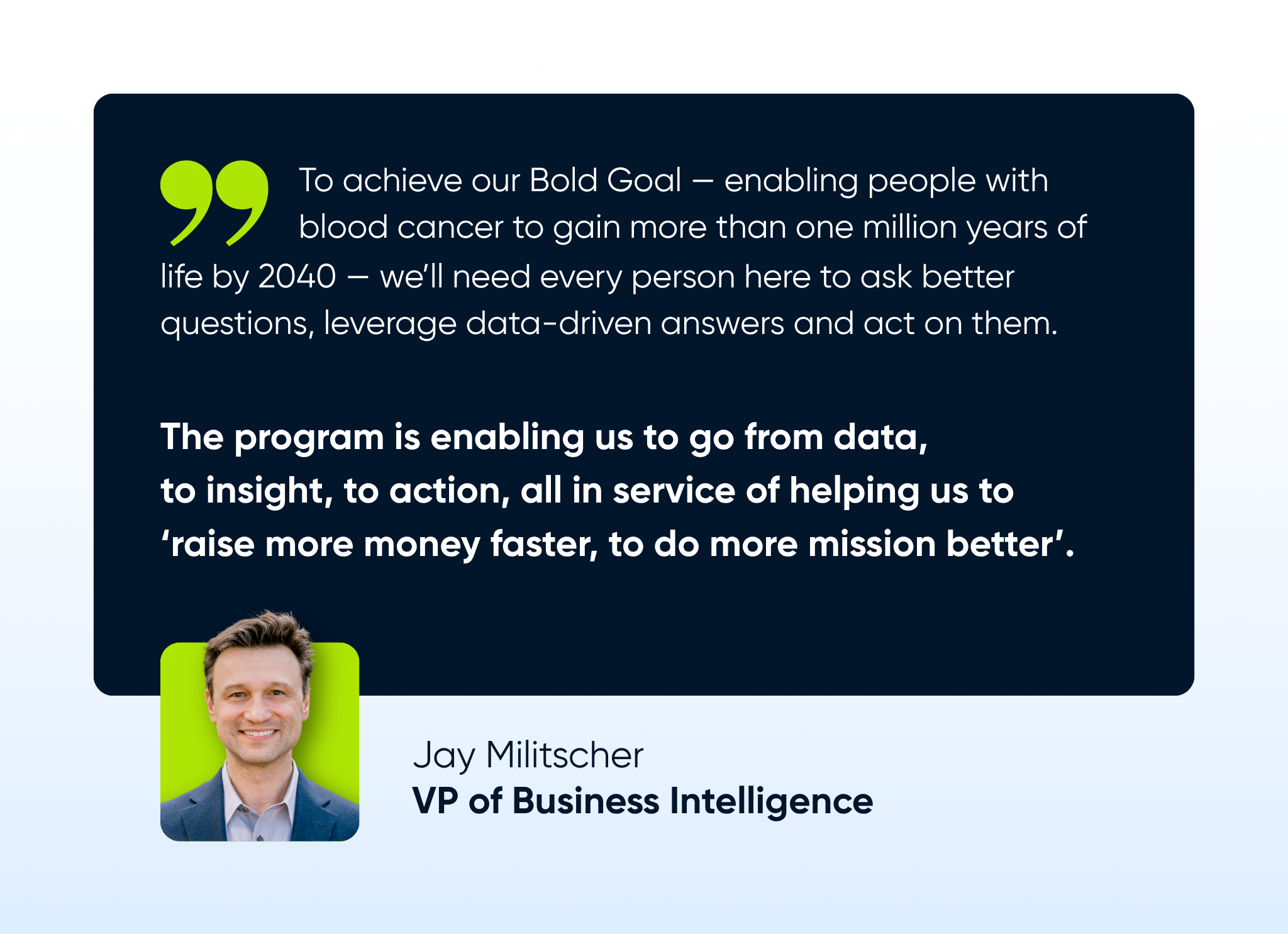
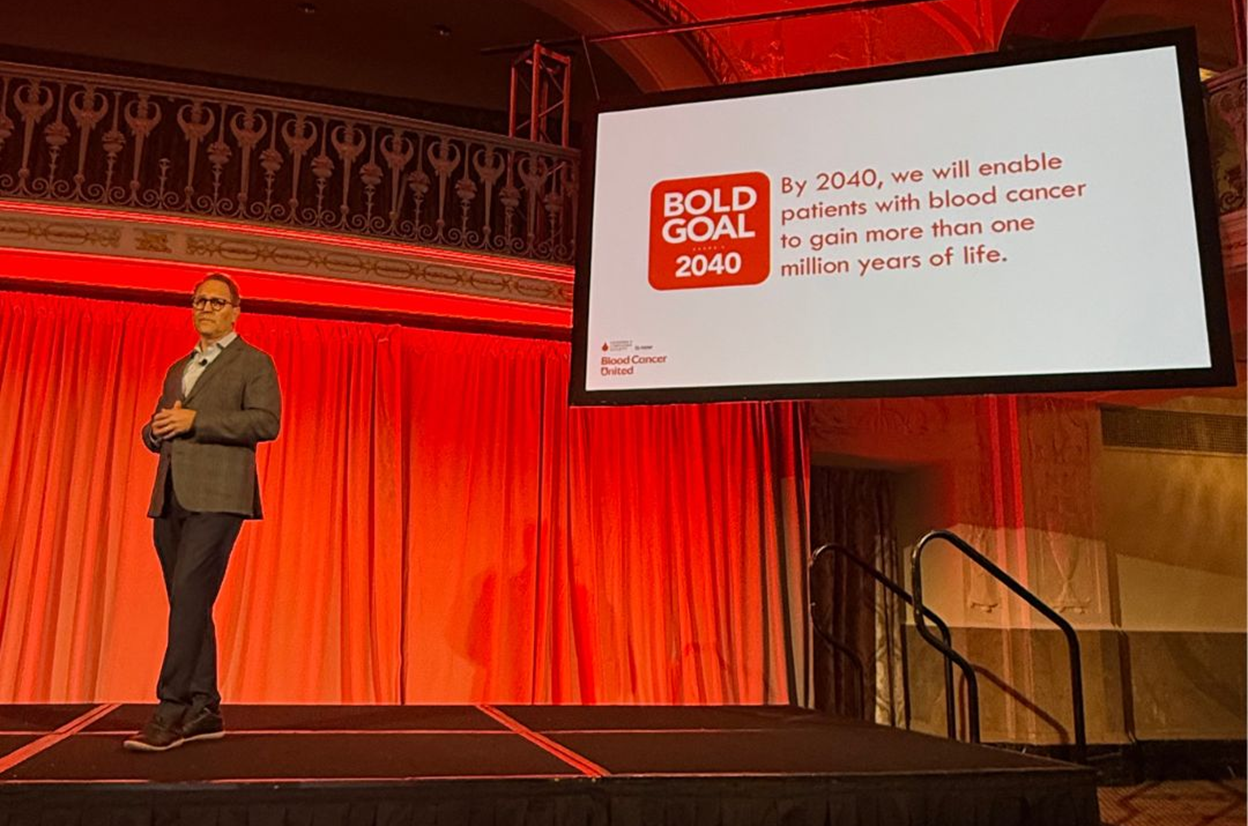
Blood Cancer United had already invested in strong technical foundations, including an Enterprise Data Warehouse on Snowflake and BI tooling, as part of a broader data strategy to help the organization make more informed decisions, strengthen relationships with constituents and ultimately “do more, better” in service of its mission to cure blood cancer and improve the quality of life of all patients and their families. Leadership recognized that technology alone would not realize the value of that investment. Capability and data fluency were needed to turn information into insight, and insight into action.
Discovery work with leadership, focus groups and change-management workshops surfaced four recurring issues:
Genericdonor experiences. Fundraising drives close to 70% of the revenue needed to support mission, yet inconsistent data entry led to impersonal communications.
- Siloed terminology. Inconsistent language eroded trust in data and slowed cross-department collaboration.
- Data as a task, not a tool. Colleagues entered data because they had to, not because they saw its value.
- Descriptive rather than predictive. Data mostly reported what had already happened, limiting the ability to spot trends.
These findings shaped four guiding pillars:
- Go data-driven to fundraise faster to advance mission impact
- Break down silos
- Make everyone a data culture role model
- Shift from data that informs to insight that drives action
The approach
Blood Cancer United and Data & AI Literacy Academy co-created a change-first program designed to shift behavior across the whole organization, starting with leadership, rather than deliver a training course to be clicked through and forgotten.
The program was built around a shared framework: data as a Library, with people becoming Readers (who confidently access and interpret information) and Authors (who create and publish insight). It drew on the ADKAR model of change (Awareness, Desire, Knowledge, Ability, Reinforcement) to support both the emotional and practical shift from "I'm not a numbers person" to "using data is part of how I work."
Learning was tailored by audience. Leaders built the foundations of analytics, moving from describing what happened to diagnosing why and deciding what to do next. Authors learned structured questioning techniques to turn vague data requests into high-impact outcomes. Readers received self-paced learning designed to bring everyone along, regardless of starting point. Communities of practice, including an Authors Book Club and a company-wide data and AI book club, were built in to reinforce learning and sustain the culture shift.
The results
Since kicking off our partnership, Blood Cancer United’s org-wide data literacy score has gone up 22% between 2024 and 2025, with 2026 expected to show further improvement.
Let’s look at the key outcomes and initiatives that have followed directly from the program.
A new dashboard that supports a cutting edge initiative
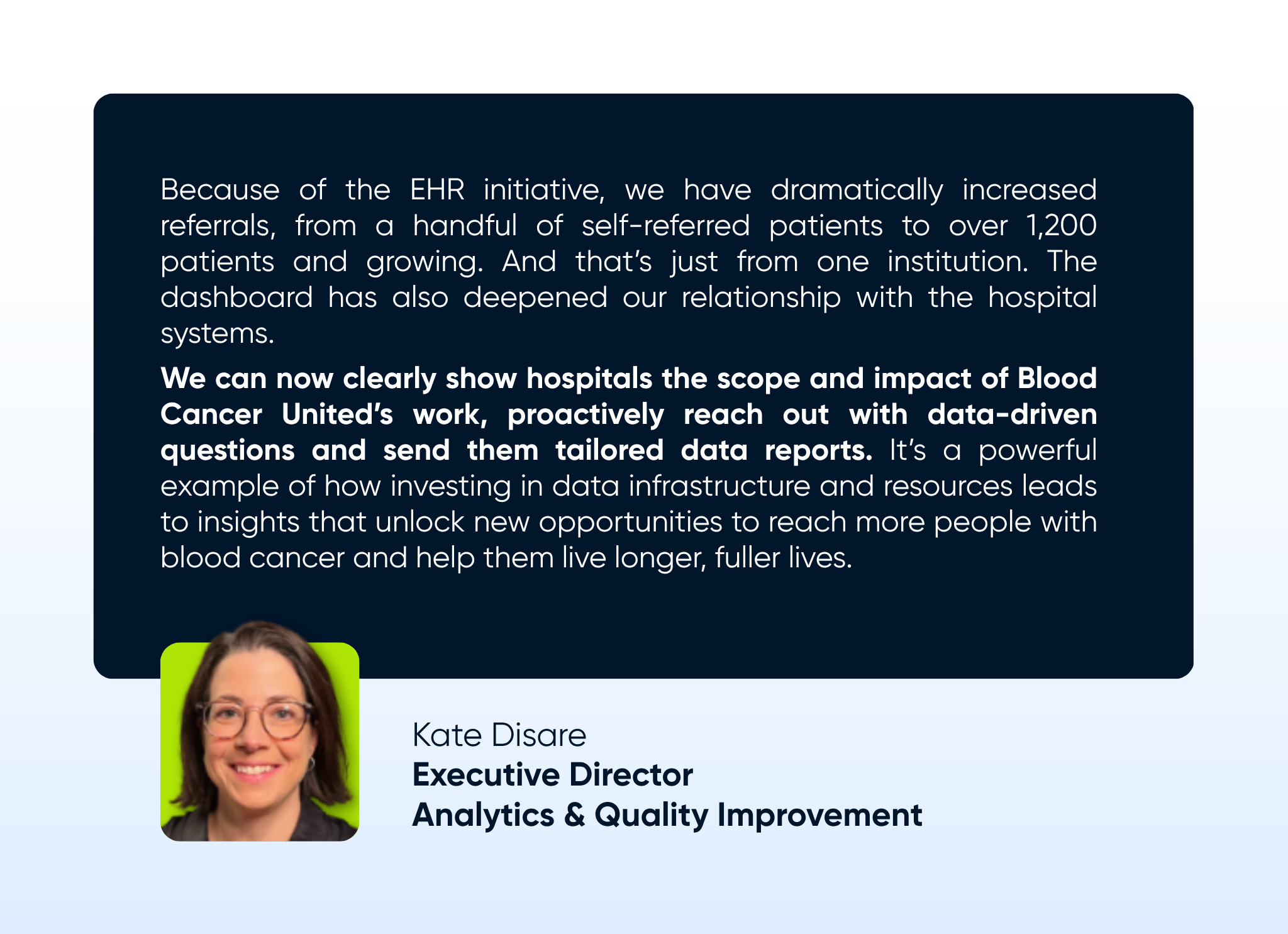
Blood Cancer United has developed Uniter™, an Electronic Health Record (EHR) integration using FHIR (Fast Healthcare Interoperability Resources) technology, aimed at helping healthcare providers at different cancer care delivery sites seamlessly connect patients with Blood Cancer United’s Information Specialists who staff the Information Resource Center (IRC). This linkage provides patients with access to the extensive support and resources available through Blood Cancer United.
The EHR referral dashboard was built by Lindsey Jackson, tapping into her newly acquired knowledge of the Blood Cancer United data warehouse environment and enhanced Tableau confidence and skills. This dashboard not only gives an overview of the volume of patients referred through the EHR integration across sites of care , showing trends over time, but it also enables insights into the demographics of referred patients, salient issues discussed with the Information Specialists, and trends in healthcare provider adoption of the EHR referral process. It has transformed how Blood Cancer United frontline teams access and act on patient referral data. Rather than pulling reports together manually through Salesforce, Blood Cancer United staff now work from a single, trusted, real-time source, one that has shifted daily operations from being reactive to proactive. This was also the first time the team sourced from the enterprise data warehouse environment, which sets a sustainable foundation for future exploration.
The dashboard has been a game changer for the initiative. Staff are now able to pull up the dashboard while meeting with the cancer centers and show in real time the healthcare providers who are referring and the ones who have stopped. This allows for a dialogue about areas for improvement and barriers to making referrals. The success of this dashboard will continue to expand, as it becomes part of the new ways of working when it comes to patient referrals.
Improving speed and clarity on donor impact
Blood Cancer United invests in groundbreaking research, provides resources, programs and services to support patients and their families, and advocates for access to quality, affordable care.
Each year, teams work together to translate Blood Cancer United’s impact into local insights and meaningful community connections. By showcasing the patients, families, and communities touched by our work, these reports illustrate Blood Cancer United’s local impact and importance, attract new donors and steward existing relationships more effectively.
The Mission Operations team plays a critical role, leading the effort to coordinate stakeholders to collect, standardize, and consolidate local impact metrics into a centralized data set that is repeatedly utilized by over 500 staff annually. While the output is a reporting dashboard, the process requires strategic alignment, disciplined data collection, and strong partnership with the teams closest to the source systems.
Overseeing the efforts, Jennifer Turner reflects on how recent training has strengthened the team’s ability to lead this work with greater rigor and influence.
“The team is now better equipped to clarify objectives, ask more targeted questions, manage stakeholder expectations, and help partners improve the quality and consistency of their inputs.”
As a result, the work has evolved from data gathering alone to a more strategic approach that connects reporting requirements to the broader fundraising and donor engagement objectives.
Shea Julian, who developed the dashboard adds, “The next phase will advance the tool from an excel based framework into Tableau, creating a more scalable, dynamic, and user-friendly resource for staff across the organization.”
This evolution demonstrates how investments in data literacy can improve capabilities, drive efficiency, strengthen enterprise reporting tools, and ultimately help fundraisers deliver more relevant, compelling impact narratives to donors. The dashboard's value compounds downstream. Employees in the regions pull figures straight from it to populate one-page flyers for fundraising campaigns and donor meetings, turning a central data asset into frontline fundraising tools without extra manual effort.
Clarifying questions are saving an estimated 6,500 hours a year
A Senior Director reported that vague requests which turned out to be unnecessary were happening at least twice a week across the organization, for every Author who attended the program, each taking two to three hours to resolve. After attending a scoping class, teams began pushing back on requests for the first time, often finding the work was not needed at all, freeing capacity for higher-value priorities.
335 potential use cases were surfaced by learners in the latest cohort through learning activities and success surveys, concrete examples of new skills being applied at work.
Leaders moving from knowing to doing
Among Leaders who responded to recent program surveys:
- 86% reported understanding where prescriptive analytics fits within the decision lifecycle
- 79% had framed insights or recommendations in a way that influenced stakeholders or team alignment
- 79% had observed measurable improvements from applying analytics practices in their work
- 71% had challenged forecasts or suggestions by interrogating assumptions, risks or missing data
A common language is taking hold
In one project, both the requesting operations team and the data team applied the same scoping framework independently, arriving at a sharper brief without extra effort on either side, a sign that the shared vocabulary introduced by the program is becoming embedded in day-to-day working practice.
As one Author put it: "It makes me feel more comfortable knowing the leaders are going through the same training as me. I can ask a question about what's been asked for, and get to more depth so I can deliver what's really needed."
The participation of Blood Cancer United in this case study does not constitute an endorsement of Data & AI Literacy Academy or its services, nor a guarantee of similar results for other organizations.
This case study was prepared by Data & AI Literacy Academy. All figures and quotes are drawn from Blood Cancer United program materials and value-capture data, with organizational facts verified against public sources.
About Blood Cancer United
Blood Cancer United® (formerly The Leukemia & Lymphoma Society) is the largest global nonprofit focused on blood cancer patient support, research, and advocacy. Since their founding in 1949, the organization has consistently evolved to better serve people affected by all 100-plus types of blood cancer. Blood Cancer United funds innovative research, offers free resources and personalized support, and advocates at state and national levels for more accessible and affordable healthcare for all patients. To learn more, visit www.BloodCancerUnited.org.
Related case studies
.png)

.png)

Unlock the power of your data
Speak with us to learn how you can embed org-wise data literacy today.

