

.png)
Have you just allocated the lion's share of your data budget to architecture, warehousing and technology? You’re not alone in waiting for sign-off on that platform or AI tool. And sure, you’ll feel like you're moving forward. But if you don’t plan well, twelve months from now, you'll be sat in a budget meeting trying to explain what value it has driven, and why you need more money to fix new challenges you just spent millions creating.
We need to talk about this. Not as vendors or as consultants with something to sell, but as people who've been in the trenches and seen this play out too many times.
Investment numbers in data & AI are booming
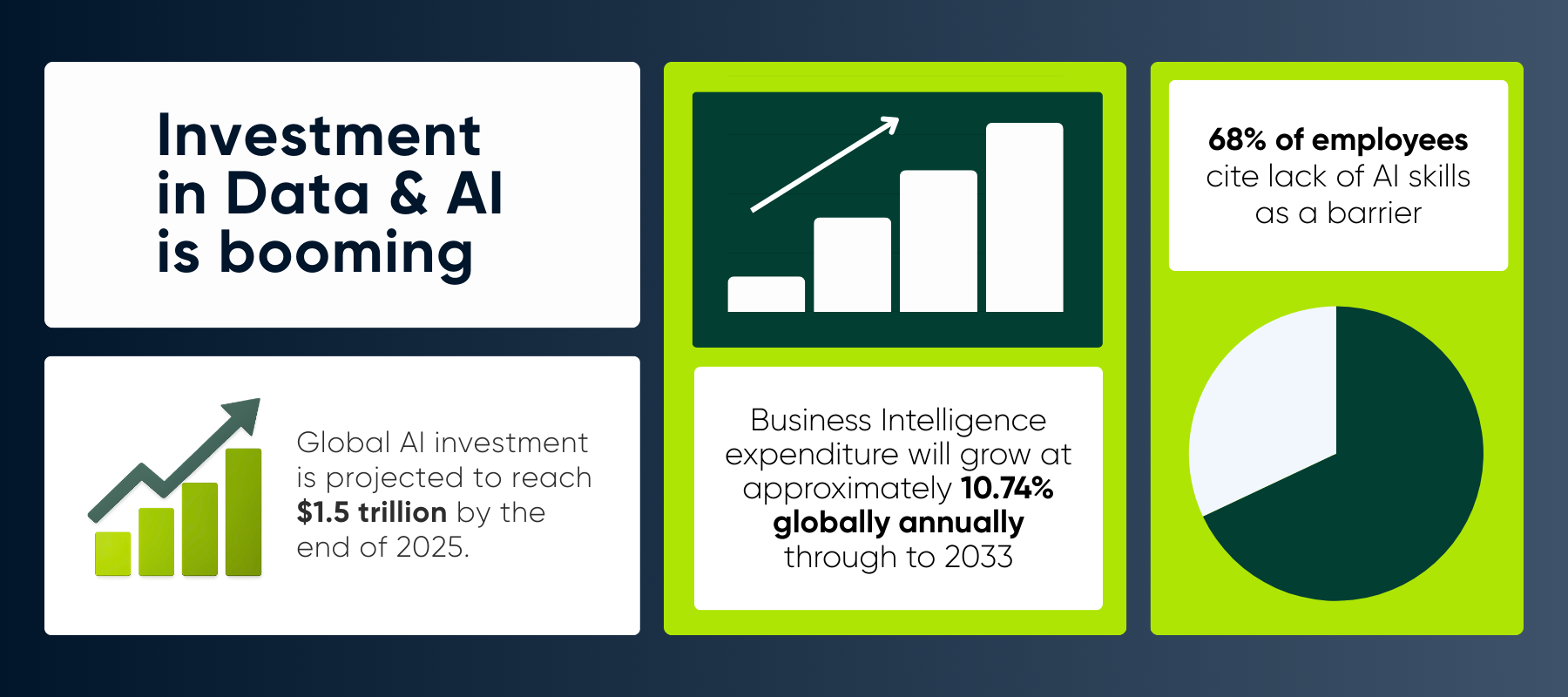
Global AI investment is projected to reach $1.5 trillion in 2025, while business intelligence expenditure continues to grow at approximately 10.74% annually through 2033. That's the kind of money that should be delivering serious returns.
So why are only 8% of employees using advanced analytics regularly, whilst 24% of companies are planning to triple their analytics spend in the next twelve months?
The maths doesn't add up. You're spraying cash at technology whilst your business isn't actually ready to adopt what you're building.
68% of employees cite lack of AI skills as a barrier, yet 89% of organisations expect to adopt generative AI by 2027. You're deploying tools to people who don't understand them, then wondering why they're not being used.
Are you building bridges no one asked for?
Think about building an actual bridge. You'd start with a clear understanding of where people need to go and why. You'd calculate the economic value of connecting point A to point B. You'd involve economists, city planners, and the communities who'll use it.
You wouldn't just hire the best engineers, give them a massive budget, and hope people show up.
Yet that's exactly what's happening with data and AI budgets. The focus is on building capability, the platform, the models, the infrastructure, without ruthlessly interrogating what business problem you're solving and who owns that outcome alongside you.
One of our clients, a logistics company, had this figured out. They weren't trying to build a data platform. They were trying to close a margin gap caused by energy cost increases. The work obviously involved data (models, dashboards, pricing analytics) but the problem statement was pure business: protect our margins without losing customers.
The result? A 7.9% revenue increase and a closed margin gap.
Now here's the question: would you rather report that you've "built a data platform and trained the team," or that you've "closed the margin gap and increased revenue"?
Your CFO knows which one they'd rather hear.
The budget paradox
Senior management increasingly sees the value in data-driven innovation, but mounting pressure on data teams and rising expectations create a paradox where CDOs must deliver more whilst managing complex data stacks and growing volumes.
You're being asked to deliver business impact whilst spending most of your budget on the very infrastructure that's supposed to enable that impact.
And here's where it gets worse: 42% of CDOs aren't even C-suite members, and many struggle with defining their roles and responsibilities within organisations. If you're not at the table where business strategy is being shaped, how are you supposed to align your budget with business outcomes?
We spoke to a CFO recently who was making a material shift in market position. When asked when they'd engaged the CDO in that decision, the response was blunt: "That's a business problem. Why would I have spoken to the CDO?"
Think about that. A major strategic shift, and the data leader wasn't even in the room.
That's not the CFO's fault. But when you’ve positioned yourself as a technology buyer, the message won’t stick that you’re a business problem solver.
What your budget actually says about you
Budgets are about choices and priorities. If 80% of your budget goes to technology and 10% each to people and process, you've made your choice clear: you believe technology alone will solve the problem.
But it won't. It never does.
The organisations that are actually succeeding, and they're rare, are doing something different. They're starting with ruthlessly clear business outcomes. They're getting commercial leaders to sign off on the maths before they spend the money and intently focused on building coalition.
And they're brave enough to switch things off. One large retailer picked their new BI tool, switched off the old one on a Friday, and turned on the new one Monday morning. Radical? Absolutely. Effective? Completely. People adopted it because they had to.
Compare that to the more common approach: spend millions on a new platform, run it alongside the old one for eighteen months "to give people time to adapt," then wonder why adoption is anaemic.
The age-old challenge of outputs versus outcomes
Here's what should terrify every CDO reading this: in 2026, demonstrating measurable business value from data and AI initiatives is no longer optional as organisations face difficult economic conditions and rising cost controls.
Your leadership team is going to start asking harder questions. "Where's the return on our investment in AI, analytics, and data management systems?"
And "we built a really good platform" isn't going to cut it as an answer.
The problem is that most data offices don't know how to answer that question. According to research Cynozure has done, only 6% of businesses over £500 million in revenue cite "unclear ROI or business case" as a top blocker, yet it absolutely should be top of the list.
Why the disconnect? Because data leaders don't see ROI as their responsibility. They see their job as building capability. Someone else can figure out the value bit.
That's got to stop.
How to build a data budget that actually works
So what does a balanced budget look like? Here's the uncomfortable truth: if you're spending 10x more on technology than you are on people, culture, and change management, you're setting yourself up to fail.
You need:
- Clear business outcomes with named owners. Not "we'll improve decision-making" but "we'll reduce customer churn in segment X by Y%, and the Head of Customer Success owns that outcome with us."
- Verified maths. Before you spend a penny, get your CFO and relevant business leaders to sign off on the expected return. If they won't, you shouldn't be doing the project.
- Budget for skills and culture. Not an afterthought. Not a "nice to have." A material investment in bringing your organisation on the journey. Organisations with mature data and AI literacy programs have increased from 35% to 46% year-over-year, whilst AI training programs have nearly doubled from 25% to 43%, yet many still treat this as optional.
- A way to measure outcomes, not just outputs. Hire someone to specifically own value realisation. Yes, spend £50-60k of your multi-million-pound budget on someone whose entire job is proving you've delivered value.
- Simplicity until you know it works. Don’t overspend on complexity if you don’t know what value it’s driving. It’s safer to take risks when you start small. This will allow you the right to get more budget.
The real blockers to moving faster with Data and AI
Research shows that legacy systems and data quality are the top blockers to moving faster with data and AI. But you can't fix legacy systems without delivering value first. Because once you start unpicking that legacy infrastructure, you'll find it's more critical than anyone thought. It's integrated with things no one documented. The people who built it have left.
So you end up spending your entire budget trying to replace something that can't be replaced, never delivering the value that would earn you the right to get more budget to finish the job.
It's a vicious cycle.
The way out? Stop trying to fix everything. Pick one business problem that will actually move the needle. One. Solve it. Measure the impact. Show the value. Then earn your way to the next problem.
The data culture problem we're not talking about
In 2024, Deloitte’s CDO survey reported that 66% of CDOs recognise culture as a problem, yet only 16% are prioritising data literacy in their budgets.
Let's be clear about what this means: two-thirds of you know people are the issue, but five-sixths of you aren't doing anything meaningful about it.
Why? Because you're worried about training people before they can use what you've built. You're concerned the timing isn't right. You're waiting for the perfect moment.
The issue is that you don't change culture by talking about it. You change culture by doing things differently and bringing people along whilst you do them, even when you’re in the messy middle.
The best programmes we've seen don't wait for the platform to be perfect. They warm up the audience as the capability is being built. By the time you're ready to launch, you've got people who understand the value, who've been part of the journey, who are actually asking for what you're building. Hope is not an adoption strategy.
Gartner projects that by 2027, more than half of CDOs will secure funding for data and AI literacy programmes, driven by enterprise failure to realise generative AI value.
That's both good news and bad news. Good news: the industry is finally waking up to the people problem. Bad news: it's being driven by failure, not foresight.
Don't be the CDO who has to justify literacy spend because your AI deployment flopped. Be the one who baked it in from the start and is now showing your peers how you got to industry-leading adoption and value realisation rates.
.png)
The honest budget questions you need to answer
Before you finalise your 2026 budget, ask yourself:
- Do you have genuine, documented buy-in from your executive peers on the business outcomes you're targeting?
- Have they signed off that if you deliver X, the investment will have paid for itself?
- Can you articulate, in business terms not data terms, what problems you're solving?
- Do your relationships with key stakeholders go beyond polite meetings into genuine partnership?
- Would your CFO describe you as someone who understands how value is created in the business?
If you can't answer yes to all of those, your budget is missing something critical.
To learn more about budgeting, check out this webinar with Greg Freeman, CEO & Founder of Data Literacy Academy and Jason Foster, CEO & Founder of Cynozure.
Related blog posts
.png)

.png)
.png)
.png)
.png)
.png)
.png)
.jpg)
.png)
.png)
.png)
.png)


Unlock the power of your data & AI
Speak with us to learn how you can embed org-wide data & AI fluency today.

