.png)
.png)
The UK government has set out a wide-ranging programme of reform for the water sector, marking one of the most significant shifts in regulatory approach in decades. If you're a water company, treatment facility, or catchment partnership, the stakes have never been higher.
A £104 billion wake-up call
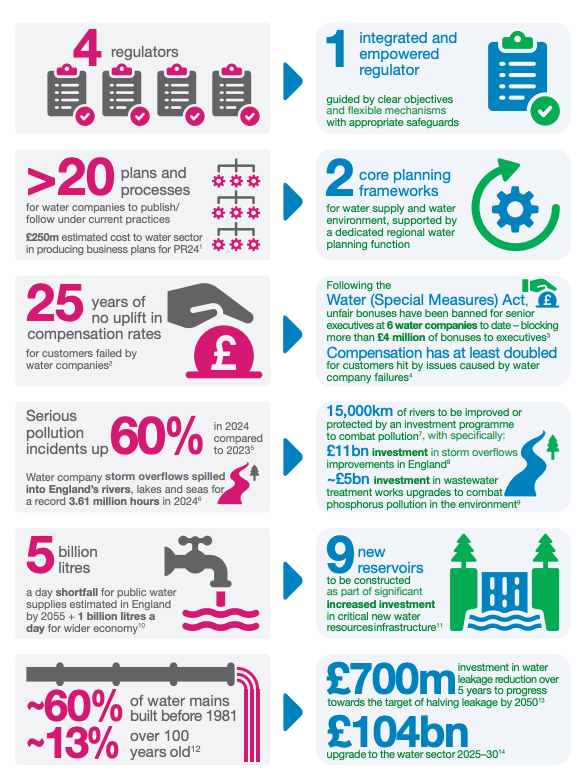
The 2026 Water White Paper from DEFRA represents a significant shift in how water companies will be expected to operate. £104 billion of planned infrastructure investment (delivering between 2025 and 2030) sits alongside tougher transparency requirements and closer regulatory scrutiny. For senior leaders, the scale of investment is matched by the scale of scrutiny that now comes with it.
Selected commitments and programmes highlighted in the White Paper include:
- £11 billion to improve 2,500 storm overflows over five years
- £5 billion for phosphorus removal at wastewater treatment works
- 15,000km of rivers to be protected by 2050
- £700 mil investment in water leakage reduction over 5 years
- Doubled funding for catchment partnerships
In addition, funding and progress will be examined together so investment without demonstrable impact will no longer be enough.
Transparency stops being voluntary
The message is clear: greater transparency means greater exposure. The White Paper explicitly calls for "tough regulation" and accountability. Every data point you report, every compliance metric you submit, every customer complaint you handle: it will be put under the microscope. Environment Secretary Emma Reynolds described reforms that leave water companies “nowhere to hide from poor performance”. In practice, this means every reported metric must be explainable, traceable, and consistent across teams.
The creation of a Water Ombudsman with legally binding powers fundamentally changes the process. When customer complaints lead to investigations, your data practices will be scrutinised.
Can you prove:
- Your storm overflow monitoring is accurate?
- Your phosphorus removal efficiency claims are valid?
- Your investment reporting is transparent and verifiable?
- Your customer communication data is compliant?
If you can't confidently answer "yes" to all of these, you're exposed.
Why data & AI literacy aren’t optional anymore
The White Paper's emphasis on "joined up regional water planning" and "minimising bureaucracy" sounds positive but it actually means more complex data sharing across multiple departments and organisations. You are no longer working with a single internal data landscape.
You are expected to integrate with:
- Regional water planning bodies, where data underpins long-term investment and environmental decisions
- Local catchment partnerships, now operating with increased funding and higher expectations around evidence and reporting
- The new Water Ombudsman, where customer complaints may trigger formal investigation and legally binding outcomes
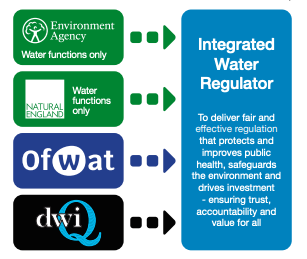
- Multiple regulatory agencies, each with their own reporting requirements, definitions, and audit processes
- Customer complaint systems, where records, timelines, and decision trails must align under scrutiny
Each connection introduces additional points where data quality, consistency, and understanding can be tested. Where those foundations are weak, accountability becomes harder to demonstrate and exposure increases.
In order to operate safely within this environment, organisations need more than systems and reporting tools. They need teams who understand the data they are sharing, the assumptions behind it, and how AI-supported outputs are created and used. Without data literacy and AI literacy across roles, inconsistencies go unnoticed, decisions become harder to explain, and risk increases as scrutiny intensifies.
AI, transparency, and accountability
AI is already part of day to day operations across the water sector, from overflow prediction and asset maintenance to customer complaint triage and environmental monitoring. Under the Water White Paper, those systems shift from background tools to areas of regulatory interest.
AI only works as well as the data and understanding behind it. Where data quality is uneven or assumptions are poorly understood, AI can scale errors quickly. When transparency increases, those errors become visible. Regulators and the Water Ombudsman will not only look at outcomes, they will look at how decisions were reached, what data was used, and who understood the limitations.
AI literacy matters because leaders and teams are increasingly expected to explain AI-supported decisions in clear, defensible terms. Automated outputs still require human judgement, oversight, and challenge. Without that capability, organisations risk relying on systems they cannot confidently defend when questioned.
Legal risk emerges through data inconsistency
Legal exposure often develops through small, compounding data issues rather than obvious failure. For example, phosphorus removal efficiency may be misreported due to gaps in data management or inconsistent interpretation. Downstream catchment partnerships may rely on those figures when designing pollution prevention strategies. If environmental harm occurs, scrutiny is likely to focus on the accuracy and governance of the original data.
A similar risk exists in customer complaint handling. Response time metrics may indicate compliance, while underlying communication logs tell a different story. When complaints escalate to the Water Ombudsman, discrepancies between reported performance and operational records are likely to be examined closely. At that point, the issue extends beyond service quality into questions of reporting integrity and accountability.
Where companies are most vulnerable
The requirements set out in the White Paper make certain data weaknesses harder to defend. In these areas, gaps in data literacy are more likely to escalate into formal challenge, enforcement action, or reputational damage once scrutiny increases.
1. Storm Overflow Monitoring
With £11 billion committed to improving around 2,500 storm overflows over the next five years, monitoring data will be closely examined. Every overflow event must be accurately recorded, reported, and interpreted. Where data is incomplete, inconsistent, or poorly understood, consequences may include:
- Regulatory enforcement where reported figures cannot be evidenced
- Heightened public and media scrutiny of environmental performance
- Legal challenge from affected communities or environmental bodies
2. Investment Reporting
Joined-up regional planning places pressure on organisations to demonstrate where money is going and what it is achieving. If investment data cannot be clearly traced to outcomes, companies may face:
- Challenges to funding allocations and future investment approvals
- Allegations of misreporting or inadequate financial oversight
- Increased scrutiny from regulators and stakeholders
3. Customer Complaint Data
The Water Ombudsman’s legally binding powers raise the stakes for complaint handling. Discrepancies between reported response times and operational records are likely to attract close attention. Outcomes may include:
- Formal findings of non-compliance
- Mandatory compensation or remedial action
- Lasting reputational damage when cases become public
4. Environmental Impact Data
Protecting 15,000 kilometres of rivers depends on accurate, defensible environmental monitoring. Errors or weak governance in this data increase the risk of:
- Regulatory intervention where environmental harm cannot be ruled out
- Significant financial penalties linked to non-compliance
- Increased scrutiny of governance and senior oversight
What links these risks
Across all of these areas, the underlying issue is rarely a lack of data or technology. Exposure tends to develop when data is interpreted differently between teams, quality is unclear, or understanding is concentrated in a small number of specialists.
Under increased scrutiny, these weaknesses surface quickly. Regulators and the public are increasingly comfortable asking detailed questions, and unclear answers are more likely to prompt deeper investigation.
How Data Literacy Academy works with the water sector
As regulatory expectations tighten, many water companies are finding that compliance pressure stems from gaps in understanding, ownership, and confidence in how data is used day to day. This is where Data Literacy Academy focuses its work.
Our programmes strengthen data capability across roles that directly influence compliance, operational decision-making, and regulatory response. By building shared understanding across teams, data can be interpreted consistently and explained with confidence under scrutiny.
For water sector organisations, this typically involves:
- Improving confidence in interpreting environmental, operational, and performance data so issues are identified and escalated earlier
- Increasing consistency in how data is reported, challenged, and explained across operations, customer services, planning, and leadership
- Strengthening awareness of governance responsibilities around accuracy, traceability, and accountability
- Reducing reliance on informal workarounds that weaken evidence during audits or investigations
- Equipping leaders to recognise early signs of risk and ask better questions of data
The result is earlier intervention, clearer accountability across teams, and fewer surprises when performance or decisions are examined externally.
What to prioritise now
In the near term, there are several practical steps organisations can take to understand their level of exposure under the new requirements:
- Review current data practices against the White Paper’s expectations around transparency, evidence, and accountability
- Identify areas of highest risk, particularly storm overflow monitoring, investment tracking, customer complaints, and environmental reporting
- Assess data literacy across teams involved in compliance, operations, planning, and customer response
- Map data dependencies with external partners, including catchment partnerships, regional planning bodies, regulators, and complaint handling systems
These steps help surface gaps early, while there is still time to address them deliberately rather than under external pressure.
For water companies preparing for increased oversight, Data Literacy Academy supports teams to build the data understanding needed to evidence decisions, identify risk earlier, and respond confidently when challenged.
If you want to understand how to assess your organisation’s data literacy, watch our webinar to explore the approach in more detail. Our Data Literacy Assessment helps pinpoint where gaps are having the greatest impact, which teams need support most urgently, and how to prioritise action for meaningful progress. It also provides a clear baseline, making it easier to track improvement over time.
Most importantly, it helps ensure that investment in data, platforms, and advanced capability translates into real value across the organisation.
If you already know support is needed, you can also book a free consultation to discuss how data literacy can support readiness under the Water White Paper.
The Water White Paper represents a substantial shift in how performance, accountability, and evidence are expected to operate across the water sector. Organisations that recognise this as a data capability challenge, rather than solely an infrastructure or technology issue, will be better placed to respond as scrutiny increases.
Related blog posts
.png)

.png)
.png)
.png)
.png)
.png)
.png)
.jpg)
.png)
.png)
.png)
.png)


Unlock the power of your data & AI
Speak with us to learn how you can embed org-wide data & AI fluency today.

