What you'll take away from this article
WhyAI investment is stalling and why it's not a technology problem- The real reason 95% of enterprise AI pilots never reach production
- Why data & AI literacy are the same conversation
- The five mistakes CDOs make when designing literacy programmes
- How to measure ROI from literacy beyond training hours and course completions
- What a genuinely data and AI literate organisation actually looks, feels and sounds like
- Why the frozen middle is where most transformation programmes quietly die
The tension nobody wants to name
Organisations are spending heavily on AI. New tools, platforms and pilots are being launched every quarter. The investment is accelerating, but this doesn't mean its impacts are measurable, and most leaders know it.
While there are certainly flaws and challenges when it comes to the technology itself, the main gap comes down to people. They're suddenly expected to use it, trust it, and derive value from it but are consistently left behind. They're mostly still untrained, unconvinced and overwhelmed, so the gap between investment and value keeps widening.
This is the tension at the centre of every boardroom conversation about data and AI in 2026: the gap between the ambition of the strategy and the readiness of the workforce to deliver it.
"If you build it, people will get bored. Or not understand. Or be overwhelmed. You can't just build it and hope for the best when 90 to 99% of people don't have that background."
— Jordan Morrow, SVP Data & AI Transformation, Agile One
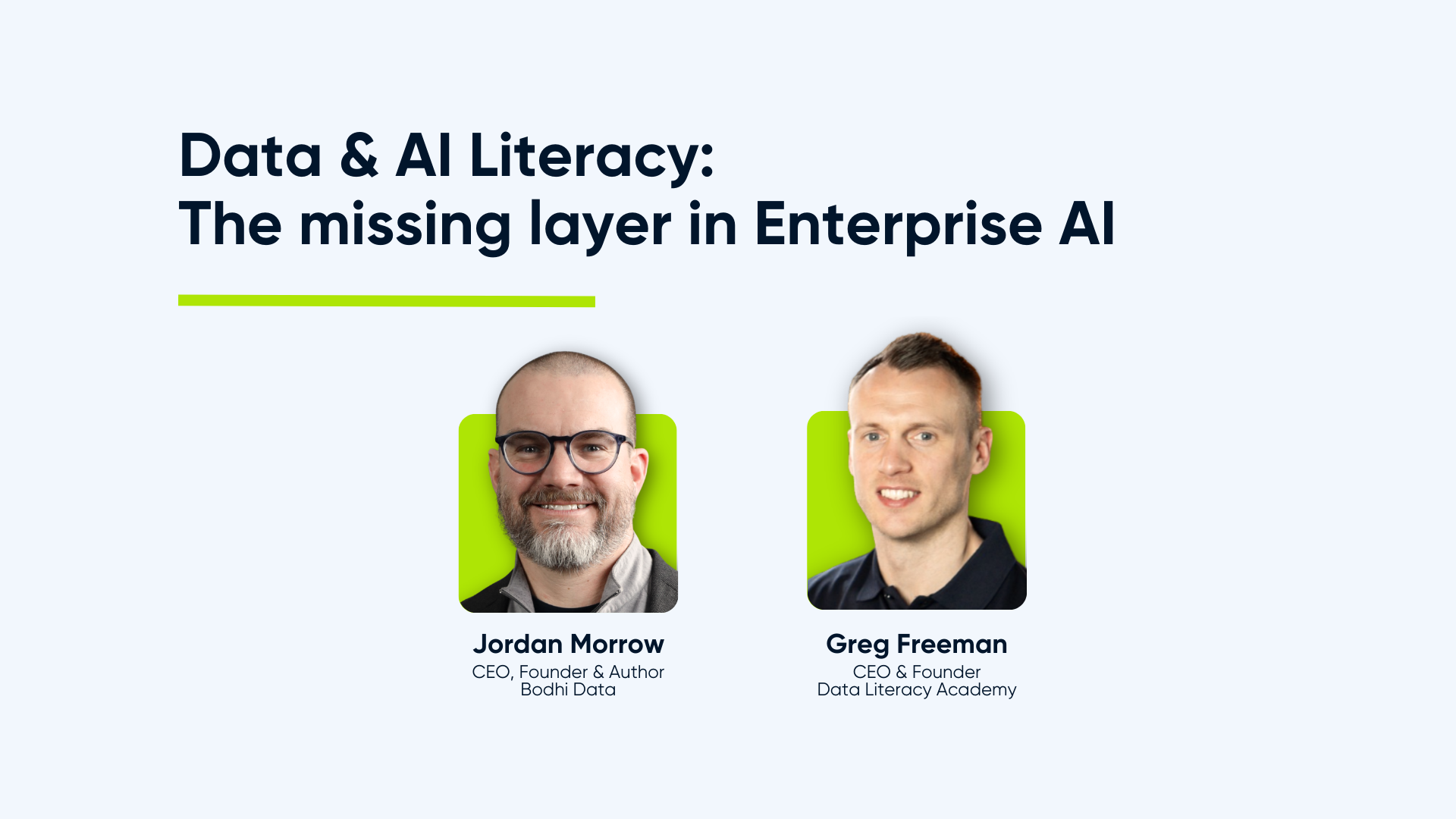
Jordan Morrow has been in this space since 2016. Often referred to as the godfather of data literacy, he has advised some of the world's most influential organisations on how to close the gap between data capability and human readiness. His view is unambiguous: the tools are not the problem.
Greg Freeman, CEO and Founder of Data Literacy Academy, agrees. His business has spent years working with large enterprises on exactly this challenge: bringing people outside the data and IT function on the journey. The pattern he sees, repeatedly, is the same.
"If people don't understand something, they don't trust it. And if they don't trust it, they're not going to use it. Literacy is the foundation of that. People will understand, then trust, then use."
— Greg Freeman, CEO & Founder, Data Literacy Academy
The numbers tell the story
The scale of the problem is not theoretical. The data is consistent, and it is damning.
- 95% of enterprise AI pilots deliver no measurable P&L impact and never reach production (MIT)
- 46% of AI leaders cite skills gaps as a major adoption barrier (McKinsey)
- 6% of corporations are seeing tangible enterprise-level AI ROI (McKinsey)
- 42% of leaders report significant positive ROI where mature literacy upskilling is in place — versus 22% without it (Industry data)
That 20-percentage-point gap between 22% and 42% is not accidental. It is the direct result of having, or rather not having people who can engage meaningfully with the tools, the data and the decisions being made.
Shadow AI compounds the problem. Workers are using AI without their organisations knowing. This has high potential of becoming a governance failure, a security risk and a sign that your executive data literacy is not where it needs to be.
"Shadow AI is thriving. And that shows me your data governance is struggling, your executive data literacy is struggling, and AI literacy is struggling. People are using AI without you knowing, and that is a governance, security and ethical risk all over the place."
— Jordan Morrow
Why AI Literacy and Data Literacy are the same conversation
There is a dangerous trend emerging in enterprises. AI is being separated from data. It's increasingly being treated as a distinct, shinier priority. CTOs and CIOs are gravitating toward AI because it carries career currency in a way that data no longer does.
The problem is that AI is only as good as the data that feeds it. Organisations that silo AI strategy from data strategy are not accelerating. They are laying the groundwork for expensive failure.
"Your data and AI strategy are your business strategy. They're one and the same. If you silo anything off, good luck. Without good data quality, you're not just missing value. You might eventually be in violation of the EU AI Act or GDPR. And a startup that did it right will have commoditised your position before you've noticed."
— Jordan Morrow
The competencies required are also the same. Whether working with data or AI, the skills that matter are: the ability to read, work with, analyse and communicate. Jordan calls these the three CsL curiosity, creativity and critical thinking. They are as relevant today as they were when he first articulated them. In fact, they are more relevant.
AI is now doing significant cognitive work for people. If your workforce hands over its thinking entirely without the critical faculties to evaluate what comes back, you are weakening the very capabilities that make humans valuable in a data-driven organisation.
Teaching people how to click buttons in Copilot is not a literacy programme. Teaching prompting alone is not a literacy programme. A literacy programme builds the mindset, the judgement and the behaviours that allow people to use data and AI to make better decisions, and to know when not to.
The data confidence problem
Most organisations treat data and AI literacy as a skills gap alone. It is not. The deeper barrier is confidence and mindset.
When you ask a room full of people whether they are data literate, most will say no. But ask those same people whether they check a weather app before travelling, or understand what fuel to put in their car, and they will say yes, of course. Those are data-informed decisions. Most people are already making them without realising it.
The job of a well-designed literacy programme is not to turn every employee into a data analyst. It is to help people recognise that they are already further along the journey than they think and to build from there.
Adults are particularly resistant to this kind of change. They have established ways of working, ingrained habits and a natural instinct to protect what they know. That is why every literacy programme needs a change management spine. Mindset and behaviour change before skill acquisition, so does desire before knowledge.
The organisations that fail are the ones that assume everyone will simply adopt. The ones that succeed treat this as a hearts-and-minds programme and design their strategy accordingly.
The five mistakes CDOs keep making
Data Literacy Academyhas designed and delivered over 100 enterprise literacy programmes. The same failure modes appear, repeatedly.
1. Overestimating the organisation's readiness
The people who come to a CDO are disproportionately those who already see the value. The other 20,000 who didn't knock on your door are a different story. Do not mistake vocal early adopters for enterprise-wide appetite.
2. Believing one size fits all
A marketing team will contain people ranging from deep analytical thinkers to those who see data as irrelevant to their work. Designing one programme for all of them is not efficiency. It is a guarantee of mediocre results across the board.
3. Assuming people want to learn
Some do. Many don't. At least not by default. That is a change management challenge, because your curriculum can be incredible, but without warming people up to the idea of what's in it for them, that won't matter. Inspiring people to grow and learn is a necessity for any cultural change.
4. Trusting the next technology solution to fix the culture
It will not. Giving someone rugby boots does not make them a World Cup contender. A tool without the capability to use it is budget spent, not progress made.
5. Being disconnected from business strategy
If the literacy programme cannot articulate its connection to organisational outcomes, whether that's revenue, risk reduction or operational efficiency, it will be the first thing cut when budgets tighten. The link to corporate and data strategy is not optional, and needs to be thought about from the start.
The Frozen Middle: Where transformation goes to die
Senior leaders sponsor data and AI programmes, and frontline workers are asked to adopt them. But between those two groups sits the middle management layer, and it is here that most transformation efforts quietly stall.
Middle managers are the people who must translate strategic intent into daily behaviour change. They manage the teams who need to adopt new ways of working. And they are also the ones most likely to feel threatened by it. It can result in them being worried about being exposed, outpaced by their own people, or made redundant by the capabilities they are supposed to enable.
"The frozen middle is the most forgotten space in data literacy. They have to answer to executives and manage those going through the programme. To me, that is the secret to success, you have to thaw it out."
— Jordan Morrow
A targeted leadership programme helps turn this essential demographic into your greatest champions. If managers are not on the journey themselves, they will, consciously or not, prevent their teams from making the full extent of progress that's possible. No frontline programme survives a hostile or disengaged middle tier.
What good looks like in practice
So what does a genuinely data and AI literate organisation feel like? Not in theory, but in practice?
The behaviours are the tell. In a literacy-mature organisation, people say 'my hypothesis is' rather than 'I think' or 'I know'. They invite challenge of their analysis. They will consistnetly question the data before acting on it. They become comfortable with uncertainty and are equipped to navigate it. The data and AI office is not seen as a separate team with a separate agenda, or as a ticket-taking help desk. They are a strategic partner in solving the organisation's actual problems.
The metrics shift too. You stop measuring training completions and start measuring the elimination of low-value work. Jordan gives a strong example from one of his customers. He saw how a 70-slide PowerPoint was replaced by six charts visible on a phone. The output was better, and of course the time saved was significant. That is data literacy delivering ROI in the real world.
Data Literacy Academy has documented similar outcomes from its client work:
- A project management team saved 270 hours by applying data thinking to how they tracked and managed resources.
- A £10 million payment risk was avoided because the right people had the skills to spot what had previously been invisible in the data.
These are not learning and development outcomes, but are business outcomes. That is both how literacy programmes should be evaluated and how they should be sold to CFOs and executive sponsors.
"We hate measuring by L&D metrics and training hours. The question is: have we saved time, reduced risk, improved decisions? Have we made the business better?"
— Greg Freeman
There is a structural tension in how organisations approach AI investment. The macroeconomic environment demands in-year returns. But meaningful AI ROI does not arrive in year one. The evidence from Davos and the organisations doing this right points to a one-to-two-year horizon, and that assumes you have built the human capability required to extract it.
If you are a data or AI leader who cannot manage that narrative with your executive team, you are in a difficult position. The answer is not to overpromise. The answer is executive literacy: ensuring the people allocating budget understand the reality of the timeline and the conditions required for returns to materialise.
Organisations that skip literacy and go straight to tooling will spend heavily, see limited results and draw the wrong conclusions. The problem was never the technology. It was always the readiness of the people expected to use it.
Five principles for getting this right
From over 100 enterprise programmes, Data Literacy Academy has distilled five principles that separate the programmes that drive measurable change from the ones that don't.
1. Assess before you build
Baseline your organisation's literacy before you design anything. If 2,000 Copilot licences have been issued and fewer than 100 are active, you need to focus on readiness.
2. Anchor to business strategy
Ideally, every element of your programme should trace back to a strategic priority. The connection between literacy and value must be explicit and visible to senior leadership at all times.
3. Find your executive sponsor and and be realistic
Not every executive will genuinely believe in the mission. Some will say the right things. Find the ones who actually do and build from there. But of course lip service is not sponsorship.
4. Address desire before knowledge
People need a reason to want to change before they will engage with what you are asking them to learn. If you skip this step, behaviour change will still struggle to shift.
5. Design for embedding, not completion
A programme that ends at the training session has already failed. The real work is what happens when people return to their desks and are left to put theory into practice. Design reinforcement into the programme from the start, behaviours, language, habits and peer accountability.
The competitive reality
AI-native startups are being built by small teams, moving quickly and targeting the inefficiencies of legacy enterprises. They do not carry the weight of 20,000 employees who never received a literacy programme and they aren't not waiting for adoption to happen organically.
The gap between what your workforce knows and what is possible with data and AI is widening. Organisations that close that gap deliberately and systematically will outcompete those who don't take this on as a priority.
"Literacy opens possibility. You now have a PhD partner available to you 24/7 in generative AI. But two parts human, two parts data, that formula only works when the human side is ready to engage."
— Jordan Morrow
Data and AI literacy is not an L&D initiative. It is the strategic infrastructure that determines whether your AI investment returns value or disappears into the trough of disillusionment.
The question is not whether your organisation needs it. The question is whether you act on that before the window closes.
Related webinars
.png)

.png)
.png)
.png)
.png)
.jpg)
.png)
.png)
.png)
.png)
.png)
.png)
.png)
.png)
.png)
Unlock the power of your data & AI
Speak with us to learn how you can embed org-wide data & AI fluency today.

