

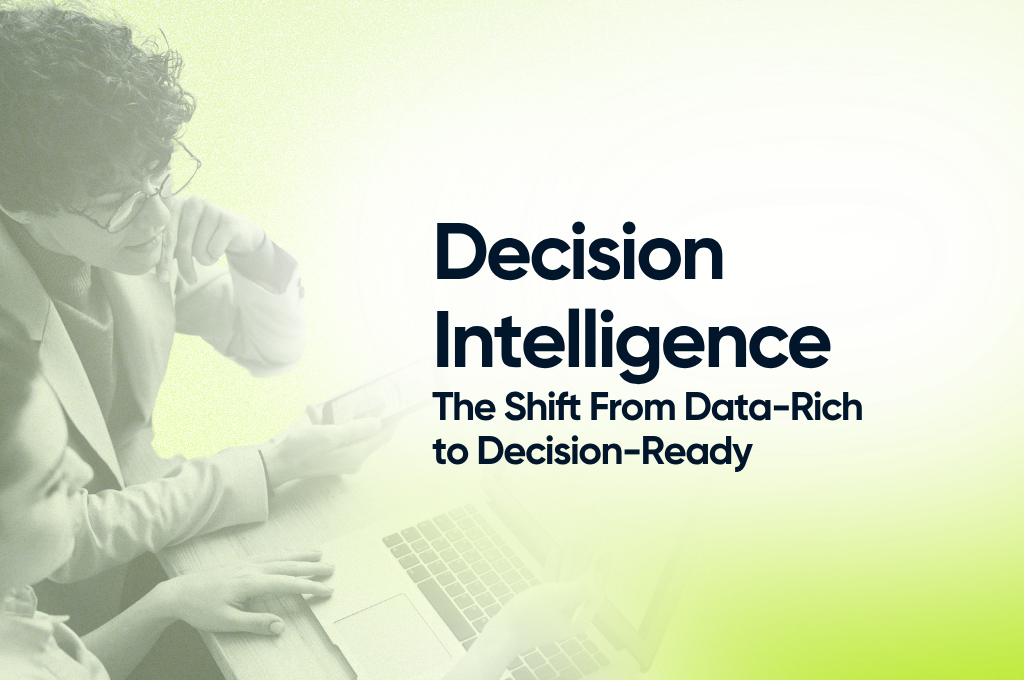
Most organisations have spent the last decade investing in data. They've upgraded systems, scaled up warehouses, delivered live dashboards and put mandatory training in place. And yet, according to Gartner, only 27% of executives fully trust the data they use for decision-making. The strategic calls, where to price, where to invest, where to cut, what's coming next, often still rely on incomplete information, contested assumptions, and whoever made the most compelling argument in the room. That gap between data investment and data-driven decision-making is exactly where decision intelligence operates.
This is a core decision-making problem that needs more than a technical solution. In fact, it's a problem that a growing number of enterprises are beginning to solve in a fundamentally different way.
What is Decision Intelligence?
Decision intelligence is a practical discipline that combines data, analytics, artificial intelligence, and human judgment to improve and automate organisational decision-making.
At its core, it applies decision modelling, AI, and analytics to support, augment, or automate decisions across all three levels of a business simultaneously: strategic decisions about direction and investment, operational decisions about inventory, pricing, and resource allocation, and tactical decisions made on the ground where both speed and accuracy matter.
What makes that possible is a trusted data foundation, not volume for its own sake, but data that reaches the right people in a form they can actually use. AI tools built on top of data that nobody trusts don't get used, or worse, they get used selectively, which in practice means they get used to confirm decisions that had already been made.
The scope of Decision Intelligence is also broader than most AI implementations. It can't usefully sit in one team's tech stack, because the decisions that drive business performance don't happen in one place. A planning team making inventory calls without accurate demand signals costs the business money. A marketing function targeting broadly rather than precisely leaves revenue on the table. A supply chain that responds to disruption rather than anticipates it pays a premium every time. Decision Intelligence is designed to address all of it as a connected system, rather than a collection of individual tools that don't talk to each other.
What is the role of the “human in the loop” in decision intelligence?
There is a version of this conversation that positions AI as a replacement for human judgment. It tends to produce the wrong outcome, and the consequences are as much commercial as they are philosophical.
Gartner's research suggests the overcorrection is already visible: by 2026, skill atrophy caused by over-reliance on generative AI is expected to push half of global organisations to reintroduce assessments designed to measure human reasoning independently of AI assistance. For senior leaders, that's worth sitting with. If the people running your business gradually lose the ability to interrogate an output, challenge a model's assumptions, or make a call when the data is ambiguous or incomplete, no AI system compensates for it and it amplifies the problem.
Decision Intelligence is built on a different premise. It gives decision-makers a more complete view of their business and the likely outcomes of different choices, but the judgment remains with the person making the call. The AI extends what that judgment can draw on. Organisations that get that balance right are finding it increasingly difficult to replicate from the outside, which makes it worth treating as a strategic priority rather than a design preference.
Why external pressure is rising
Beyond internal performance, the commercial environment itself is shifting in ways that make this more urgent.
Gartner projects that by 2028, 90% of B2B procurement will run through AI agents, with over $15 trillion in spend moving through autonomous, machine-to-machine channels. That has direct consequences for how businesses generate and protect revenue. Traditional approaches to visibility and sales, search, paid advertising, relationship-led pipelines, are built around a human buyer doing research and weighing options. That buyer is increasingly being replaced by an agent making decisions on their behalf, and those agents operate on entirely different inputs.
The governance risk is becoming equally concrete. Gartner expects legal claims from AI decision failures to exceed 2,000 cases globally by the end of 2026, concentrated in healthcare, finance, and public safety. The consistent factor across those failures is AI operating without sufficient human accountability and without the ability to explain its own reasoning. Explainability and clean data are the foundation, not a finishing layer, and organisations treating them as the latter are finding that out the hard way.
What the online transition tells us
Companies that fall behind on Decision Intelligence will feel the same effects as those that were late to move online.
It's a pointed parallel because technology adoption is never just an abstract concept. It's about the compounding structural advantage that early movers built, and how long it took competitors to close the gap, if they ever did. The businesses that moved online early captured customer habits, built scalable infrastructure, and established pricing power that proved very hard to replicate once the window had closed.
The window for building an early mover advantage in Decision Intelligence is still open, but is your organisation moving through it?
Where does your organisation stand?
Most leadership and executive teams have a sense that AI should be doing more for their business than it currently is. Fewer have a clear picture of where the specific gaps are, which decisions are most exposed, and what closing those gaps would actually look like in practice.
Our Decision Intelligence diagnostic maps your current capability against where the commercial pressure is highest in your business. It’s seven questions, specific to your organisation, and it tells you something useful regardless of what you decide to do next.
.png)
Related blog posts

.png)
.png)
.png)
.png)
.png)
.jpg)
.png)
.png)
.png)
.png)
Unlock the power of your data & AI
Speak with us to learn how you can embed org-wide data & AI fluency today.

