
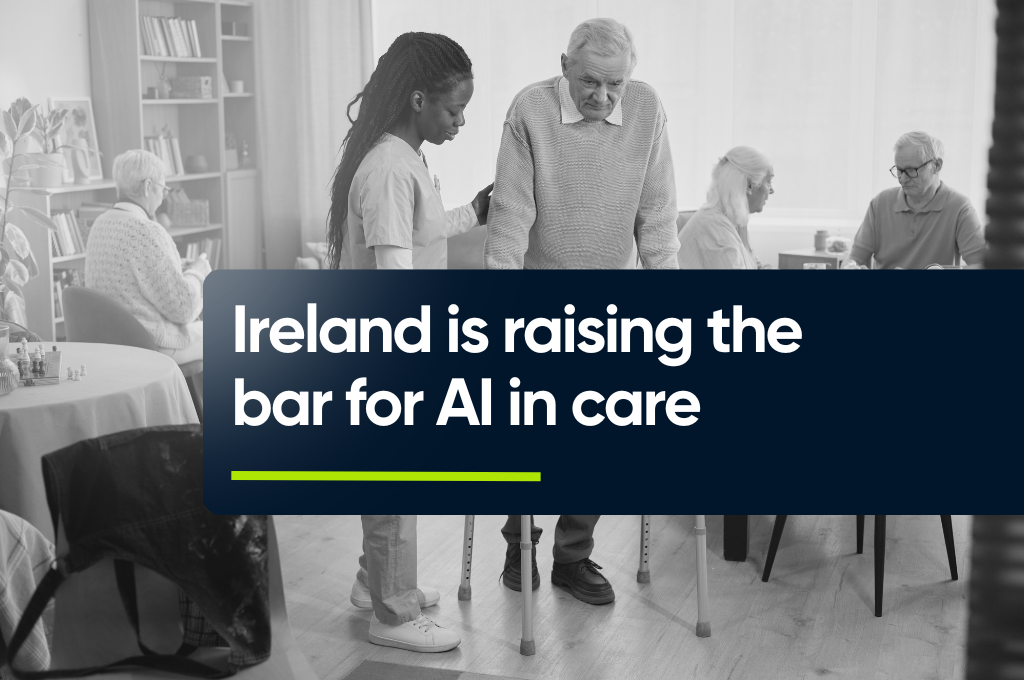
For health and social care providers in Ireland, the familiar “wait and see” approach to AI has become much harder to defend.
Three different instruments, one clear direction
Ireland now has three layers shaping how AI should be used in health and social care. They do different jobs, but they point towards the same operational conclusion: people need the knowledge and judgement to use AI safely, responsibly and with clear accountability.
The EU AI Act is the binding legal layer. Article 4 has applied since February 2025 and requires providers and deployers of AI systems to take measures that support the development of AI literacy. Those measures should reflect the knowledge, experience, education and training of the people involved, the context in which the system is used and the people who may be affected. The provision was amended in July 2026 to clarify that no specific level of AI literacy is mandated for an individual, while the organisational obligation remains.
AI for Care, Ireland’s national strategy for healthcare from 2026 to 2030, supplies the direction of travel. It sets out ambitions across clinical care, operations, research and innovation, and public health. Crucially, it says Ireland will immediately prioritise AI literacy across the workforce, patients and service users.
HIQA’s final National Guidance for the Responsible and Safe Use of Artificial Intelligence in Health and Social Care Services then brings that direction into the care setting. Published in July 2026, it explains what good practice looks like for services and staff through four connected principles: accountability, a human rights-based approach, safety and wellbeing, and responsiveness.
This may seem overwhelming, but we've broken it down and suggested a plan in our Irish care provider’s guide to AI readiness article.
Why the overlap matters
It would be easy to send each layer to a different owner. The legal department takes the Act. Strategy and tech teams look after AI for Care. Quality or clinical governance reads the HIQA guidance. The learning and development team is asked to find a course or training video.
That division may look tidy on an organisational chart or in a board meeting, but it creates gaps and silos in practice. The same employee may be expected to use an approved AI tool, protect personal data, recognise a misleading output, maintain human judgement, explain its use to a person receiving care and escalate a concern. Those behaviours can’t be produced or protected by separate policy documents.
Therefore, AI readiness becomes a care quality issue. A technically sound tool can still create poor outcomes if people misunderstand its intended purpose, use it outside the approved workflow or accept its output uncritically. Equally, an organisation can become so cautious that useful tools never progress beyond isolated pilots because nobody has built the confidence to use them properly.
A policy cannot challenge an AI decision
HIQA gives policy an important role, from governance and authorised-tool inventories to risk management, complaints procedures and clear accountability. But its guidance does not stop at documentation. It says services have a responsibility to assess what training people need and provide ongoing education shaped around their role, technical knowledge and the context in which they use AI.
A completion report only shows that someone attended a course. It does not tell you whether a care-home manager can challenge an unreliable recommendation, whether a procurement lead can test a supplier’s claims, or whether frontline staff know what information must never be entered into a public AI tool.
Care providers need a shared foundation covering approved use, organisational policy and escalation. From there, learning should reflect the decisions each role makes and the risks attached to them. The greater the responsibility or potential impact, the deeper the support needs to go.
That is the difference between issuing a policy and changing practice. People need to understand what is changing in their work, feel confident questioning AI and know exactly what to do when something goes wrong.
The opportunity for care providers
None of this has to be just another compliance burden. Done well, it replaces a mess of one-off pilots with something everyone is pulling in the same direction on.
Right now, most leaders can't say with confidence where AI is being used across their organisation, by whom, or how well. A shared foundation with a shared language fixes that first problem. Role-based education gets tools to the people who can actually use them properly, instead of everyone guessing at the edges. And testing people on real scenarios, instead of multiple choice quiz questions, tells you honestly where confidence is earned and where it isn't.
For multi-site providers, that consistency is especially valuable. The aim isn't to make every employee an AI specialist. It's to make sure every person has the level of understanding their decisions require.
The organisations that act now can connect governance, care quality and adoption through the same workforce programme rather than depending on a policy doc that only needs a signature.
How Data & AI Literacy Academy helps
Data & AI Literacy Academy helps organisations translate broad AI expectations into role-relevant capability. We start by identifying where AI touches work and decisions, map the audiences involved, establish the common foundation and build deeper pathways where responsibility and impact are greater.
In care, that means giving people the confidence to use AI where it adds value, the judgement to question it and the clarity to know when human expertise must lead.
This article is informative content, not legal advice. Sources below:
- HIQA, National Guidance for the Responsible and Safe Use of Artificial Intelligence in Health and Social Care Services, July 2026, especially pp. 17, 25–26, 44–47 and 63–68.
- Department of Health and HSE, AI for Care: The Artificial Intelligence Strategy for Healthcare in Ireland 2026–2030, especially pp. 16 and 38–40.
- Regulation (EU) 2024/1689, Article 4 (AI literacy), consolidated text dated 27 July 2026.
Related blog posts

.png)
.png)
.png)
.png)

.png)
.jpg)
.png)
.png)
.png)
.png)
Unlock the power of your data & AI
Speak with us to learn how you can embed org-wide data & AI fluency today.

