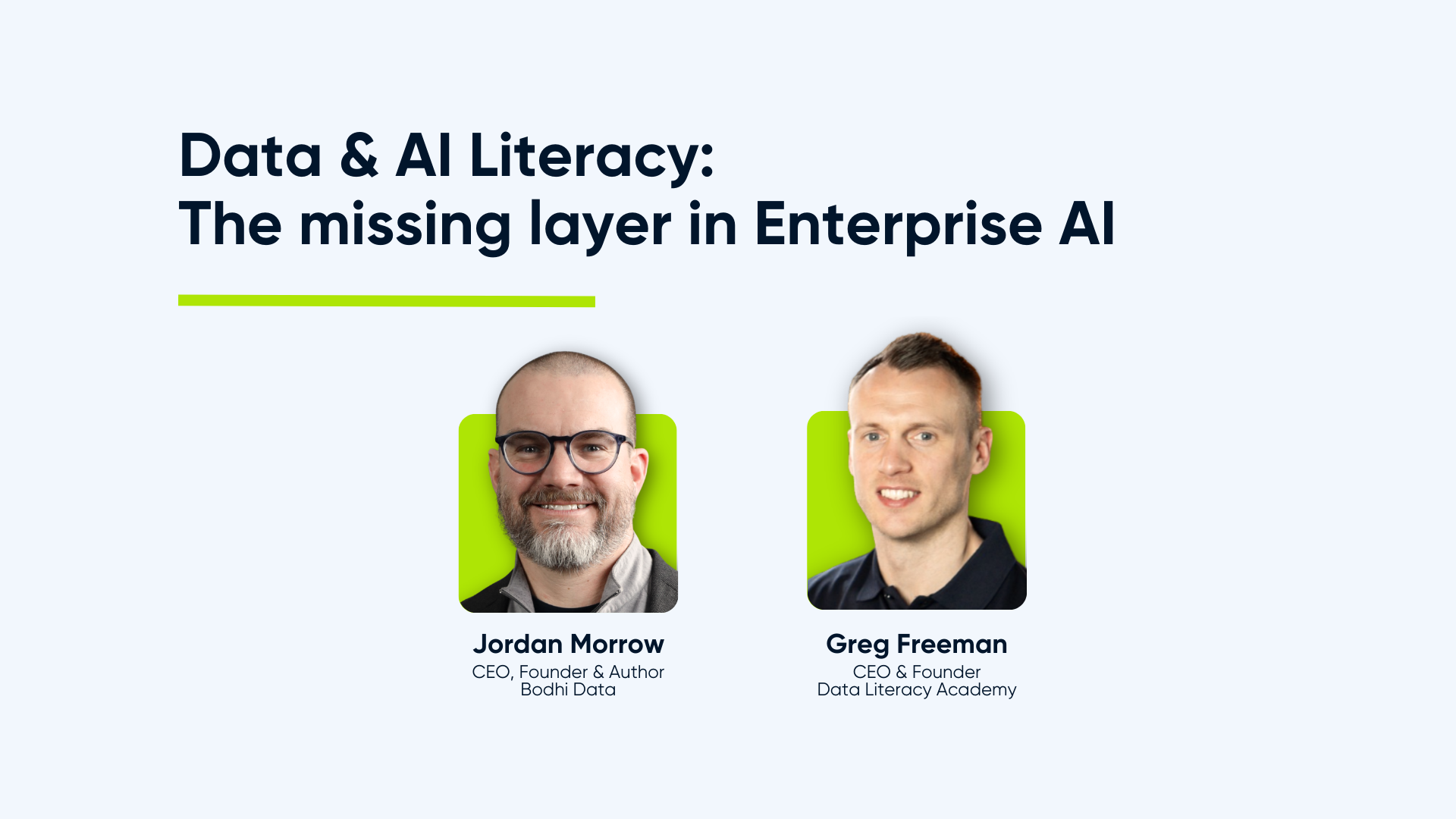
Greg Freeman | CEO & Founder, Data and AI Literacy Academy
We'll let a few more people get settled and then we'll kick off. If you've joined one of mine and Jordan's webinars before, you'll have a good feel for the style. There will be some slides to give us context and support, but there'll also be me asking Jordan a chunk of questions and him sharing his opinions on the different themes within the deck.
It's a good opportunity for Jordan to answer questions from the Q&A, he's far more seasoned at working through those in real time than I am. We'll do all of those things as usual.
Proving ROI and demonstrating value is hard from data programmes generally, or you could argue we as an industry make it hard for ourselves, which might be an interesting topic in itself. It's certainly difficult from a data and AI literacy perspective, so we'll talk about it in that context.
Jordan Morrow | CEO & Founder, Bodhi Data; SVP of Data & AI Transformation, Agile One
They're talking about the heat you're experiencing right now, Greg.
Greg Freeman
Yes, if anybody's joining from the UK, bless you, because if you're dealing with the same lack of air con and 35°C / 90°F temperatures, good on you. It's a hard yard right now.
Let's get going. Very quickly, in case you haven't come across either of us before, my name is Greg Freeman. I'm the CEO and founder of Data and AI Literacy Academy. We are a business that specialises purely in taking enterprise organisations through their own data, AI, literacy, and culture journey. One of the big things we focus on and care about is evidencing ROI, so that you, as a stakeholder, can be proud of the work you've done and brought into your organisation, and so that we as a partner can show that we've been valuable and hopefully continue to deliver value over the years ahead.
I'll hand over to Jordan to introduce himself.
Jordan Morrow
Thank you, Greg. My name is Jordan Morrow. I'm the CEO and founder of Bounty Data and the Senior Vice President of Data and AI Transformation at Agile One. I've become good friends with the Data and AI Literacy Academy. My background is that I helped invent the field of data literacy, and I'm selective about who I partner with. I genuinely believe the Academy is the number one organisation — not just in Europe, but on the planet — doing this work and helping organisations succeed from a data and AI literacy perspective. So, I'm happy to be partnering with them.
Greg Freeman
That's very kind, Jordan. We appreciate you.
Let's start with the premise: why does today's topic matter?
Every enterprise organisation has access to the same AI capabilities. We don't work with a single business that says it can't afford to engage with AI at some level. Microsoft, Amazon, Google, Anthropic, whoever it is, they will sell you their services, and you do have the money to buy them. I'm not saying everyone can spend exactly the same amount, but the fundamental point is that the opportunity is widely available, and most enterprise organisations are ready to go for it.
However, spending money on technology and spending money on consultancies to implement it is not the competitive advantage. The competitive advantage comes from the ability to design, run, and use data and AI in ways that consistently impact day-to-day decisions across the organisation, the way you operate, the efficiencies, the behaviours, the decisions made at executive level right down to the frontline worker speaking to a customer. Are those things actually being adopted and used to make money, save money, beat your competition, or deliver value for your stakeholders? The best outcomes come from actually doing it, improving decisions and improving actions across the organisation.
So how do we measure that transformation is actually taking place? There's a compelling stat here: organisations with structured literacy programmes see 3x faster AI adoption. That's reflected in a lot of the research from major organisations, consultancies like Accenture and McKinsey are running their own internal structured literacy programmes for their people and seeing significantly faster adoption as a result.
So what should we actually be measuring?
You have your human metrics, the kind of L&D-type measures. Pre- and post-skill assessments, self-efficacy tracking, and confidence scores: how does an individual rate themselves before the education versus after? Knowledge or competency tests before and after the process. These are your human baseline metrics and are part of any L&D programme. However, they are not enough. They are not what will help you, as a data leader, AI leader, or operations leader, show the value of investing in this process. Ultimately, confidence is one thing — what we actually care about is changing the operational metrics and business impact figures.
Things like adoption rates across tools. I was speaking to an organisation about four or five days ago, they had invested in 7,000 Copilot licences. Not uncommon, not even a poor decision. But when they looked at their active users, fewer than 50% of those 7,000 had actually used it. These are all knowledge workers in a business of around 14,000 people, half knowledge workers, half manual workers. Every knowledge worker had access to a Copilot licence and had been told about it, yet fewer than half had used it. There's a massive adoption gap, you've already spent the money, but are you getting anything out of it?
You also want to track things like frequency of data-driven decisions. Jordan has spoken about this before, not just the frequency, but the speed to data-driven decisions and speed to insight. Jordan, do you want to talk about why that's such an important measure?
Jordan Morrow
In the age of AI, we're missing a great opportunity to create new metrics and measurements around data and AI, specifically around the velocity with which we can reach insight.
What that means is, yes, we have to upskill and reskill, and in parallel, we should be innovating and creating. I prefer those words over "disrupt," which I think has a negative connotation.
With AI as essentially a PhD on our shoulder at our fingertips, we have the ability to move quickly. The human remains in the loop, that must always remain. But that ability to reach insight faster should empower us to be more strategic, to eliminate some of the mundane work. So velocity of insight, velocity of decisions, those things should absolutely be part of how we measure this.
Greg Freeman
Fully agree.
Then you have workflow integration stats. A key point here: you could simply measure which processes didn't have automation and integration before and now do. But a better view, in our opinion, is how many workflows, data flows, or business processes have been genuinely redesigned around data and AI.
If all you're doing is adding AI as an overlay on poor existing processes, and most human processes aren't that well designed, because they were built 20 years ago and patched repeatedly since, all you're doing is making a bad process more efficient. What we should really be asking is: have we burned down some processes, removed all the clutter, streamlined them, and then seen improvements? That's what meaningful measurement of workflow integration impact looks like.
In terms of business impact, something we focus on quite a lot at the Academy, the quality of use cases coming out of the business is a key indicator. As an organisation becomes more data and AI literate, people become far more aware of the business problems they can actually solve using data and AI. Rather than simply putting Copilot on a broken process to make bits of it faster, they're coming to you, the data office, the AI office, the technology team, and saying: I want to burn that process down and redesign it with you. That is the quality of use case that emerges from a literacy programme, and stacking those up and compounding them over time produces measurable, direct ROI.
Then you have throughput and efficiency gains: do processes require fewer people or happen faster? Are you getting answers back to customers more quickly? Is sales moving through the pipeline faster? Are you identifying that a marketing message is wrong sooner? All of that fits into throughput and efficiency gains.
And then a really big one: reduction in rework. A major value of literacy is that conversations between the data team, the AI team, and the wider business improve. Requests coming in become more structured and more valuable, which means the data and AI office does less rework, spends less time, and experiences less friction. Measuring how much of that exists now versus in 12 or 18 months' time will be a significant win.
Jordan Morrow
Greg, there's a question in the chat we should address right here since L&D has been part of the conversation. Jess asks: how do we communicate to stakeholders that this is beyond L&D thinking, in businesses where L&D is being scaled back?
The reality is, Jess, the communication, transparency, and messaging are front of mind when thinking about data and AI. A lot of the focus falls on the technology, but 90 to 99% of your success might be driven by the people. You can have the most brilliant model or data-driven solution in the world, and nobody touches it — not because the tool isn't good, but because the people aren't confident, comfortable, or sure how to use it.
So we have to build communication and transparency around the fact that 90 to 99% of people did not go to school to be data and AI professionals. Tools aren't strategies, they are tools to help the strategy succeed. And if we remove the part of the organisation designed to help this thrive, L&D, we lose.
I don't like taking the negative route, but sometimes you have to be direct and say: if we don't do this, we will fall behind. At Davos this year, one of the top AI insights was reskilling. We have a skills gap, and we have to address it. Find the documentation, find the studies, and have the right conversations.
Greg Freeman
Jess, we don't believe this is just an L&D problem. In fact, most programmes run through L&D alone are far less successful than those run through L&D in partnership with, or typically led by, the data office, the AI office, or the technology office. L&D doesn't benefit from this change nearly as much as senior business stakeholders and the data and AI office do.
If it's being steered as an L&D-only initiative, especially as L&D budgets and headcount are being stripped back, that's a problem. We typically work with the data and AI leader as our primary contact. We will help you make the case that this is a data and AI strategy point, and therefore a business strategy point, not just an L&D problem.
Unlike most L&D programmes, this is extremely horizontal. It impacts the business at the highest level and delivers outcomes that aren't purely L&D-focused.
Here's a real example. One of our learners identified that a decision-making process had stalled around spending £35,000 on a technology solution. Leaders didn't have the insights they needed to make a clear decision on whether the investment would deliver the planned return. She learned from our structured literacy programme how to reframe the data and present it upwards into her exec meeting. She proved that the £35,000 investment would actually save £400,000 annually, flipping the story, cutting the data in different ways, looking at it from different angles. In doing so, she not only unlocked a decision that had been stalled, but also delivered a time-to-value benefit in the £50k region, plus £400k annually. That's the value of people learning from a programme and immediately applying it to real-world conversations.
Secondly, a throughput and optimisation ROI case. A project management function was preparing weekly project plans to report upwards to leaders. These weren't junior people — they were mid-to-senior professionals being asked to prepare programme evidence plans every week. Through the programme, they developed the mindset and skills to reduce that preparation from 2.5 days per month to 1 day, saving 270 hours across the year, multiplied across 7 senior leaders. When you roll that up and consider it's likely happening across every programme and project team in the organisation, the numbers become massively impactful.
And finally, risk and effort avoidance which carries its own ROI, whether that's fine avoidance or penalty avoidance. In this case, through a data quality module in the learning, a learner realised that data going through to a vendor was incorrect, showing an underperformance on their side. It took them reviewing it line by line to identify the quality issue and implement a fix.
What this prevented was a team of six senior leaders spending a week investigating why the process had gone wrong, 60 hours avoided. It also unblocked payment that had been held because the supplier couldn't demonstrate the work had been completed. By engaging with data quality in the right way and making it applied to their actual work, this person identified a real problem that unlocked significant cash flow.
Jordan, anything to add?
Jordan Morrow
I was just thinking about Karissa's comment responding to Jess's question, she said she'd reframe this less as reskilling and more as a business imperative that will increase critical thinking, forward movement, and innovation.
That connects directly to data quality. AI is the exciting topic. Data quality is not. But your AI will simply be useless if the underlying data quality is poor. So let's make data quality a more central part of the vision. It's not just reskilling, it is an imperative.
I had this exact conversation last week in DC at a workshop. Someone raised data governance, and I said: you're right, it needs to be a fundamental part of data literacy. People need to understand where they fit in the data lineage.
We are starting to lose sight of data literacy in the pace of AI development. Data literacy is as important a part of AI literacy as it ever was. Things like quality, governance, and doing things the right way are imperatives of AI literacy, not just a data literacy concern. The surrounding context here is significant: the organisation had just signed off on a £300 million version of the same programme. If these data quality issues hadn't been identified now, the problems would have been 3.5 times worse as that programme progressed over the next three years. Getting things right now sets us up to make better decisions and use AI more readily in the future.
Greg Freeman
We frame this as how the CDO should think about ROI, and I think the CDO should be thinking about ROI constantly. But how has the CDAO role changed?
In the past, businesses hired CDOs for their technical expertise, their ability to manage analysts and engineers, run hands-on experiments, and arrange insights. That was the hiring profile.
What came through clearly at the Data IQ 100 event in Nashville, and the UK market follows quickly, is that the CDAO role is now really about decision intelligence: the speed at which the business makes decisions, the outcomes achieved, and how to operationalise that at scale. It isn't just about having good data people who do data things. It's about scaling that capability across all operations in the business. And that can be genuinely hard if you're a data leader yourself, and AI is relatively new to you, but you're being leaned on by your senior peers for all the expertise around AI and operationalising it at scale.
Every CDO, CDAO, and CTO we met in the US described it as an organisational change process. This is not just a technology programme anymore, it requires commerciality that makes you an enterprise operator.
The CDOs and senior data and AI professionals in the US were very clear: they have to know the business, the business's ways of working, its strategy and operations, as well as anyone in the organisation. In fact, we recently ran a programme at a major pension fund where the entire focus wasn't on making business people more data and AI literate, it was on making their data professionals, AI professionals, and technology professionals more business literate. We taught them about business strategy and business operating models, and how data and AI could support those. That is a different way of looking at literacy and a different way of looking at the role.
Jordan, what are you seeing in the US?
Jordan Morrow
You nailed it. Literacy is two sides of the same coin, data literacy for non-data professionals, and business literacy for data professionals. That's actually what my fourth book was about: business fundamentals for the data professional. When data literacy started gaining traction, there was a tendency to blame non-data people for data initiatives not working. That's not the real issue. Data people often lack the business background, and business people often lack the data background. The rising tide lifts all boats.
The CDAO or CAIO role, whatever you want to call it, has to be integrated as a true business partner. Years ago, these roles would be isolated, not reporting directly to the CEO. But what has occurred, and what AI has forced, is that these are now decision catalyst and business operation catalyst roles.
Your data and AI strategy is simply your business strategy, and how data and AI supports it. That's it. For the CDAO role to truly succeed, it has to be fully integrated, not separate. And as Karissa said, that means change management literacy is absolutely critical.
Greg Freeman
100%. A CDAO who doesn't understand behavioural science, and the impact that decisions and ways of working have on people, is going to struggle over the next few years. Adoption is fundamentally about behavioural science and behavioural change.
So what do we actually need from the CDAO role? If you're in this room thinking you want to be a CDAO in two or five years' time, getting your head around these priorities now, rather than continuing to overindex on technical capability or data product delivery, is what will change the game for you.
The amount of CDOs and CDAOs I speak to who still can't clearly articulate the business strategy, the commercial strategy, or why their department's role in that is critical, it's painful, and it makes for a very difficult conversation when they go to speak to the CEO, CFO, or COO. When we lose those relationships, we lose everything. It's also one of the reasons for such high turnover in these roles.
That change architecture Jordan and I both referenced, look at models like UCL's behavioural science frameworks. Get your head around how people are motivated, what drives their decisions, what causes them to resist certain things. Because if you don't understand it at a behavioural science level, you won't know how to influence your peers, the people above you, or the rest of the organisation to become part of it.
And then you also become an evidence producer: how does your team help key senior leaders prove whether they should or shouldn't do something? Not just proving what has or hasn't been done, but as a decision is being made, do you have the data, the AI output, the evidence to show that the right decision is about to be made? That is a different type of strategic leader than what we've seen over the last five to ten years.
Now let's get into the biggest reasons data and AI programmes stall and fail.
The capability that's built doesn't automatically result in changed behaviour. Going back to that example: 7,000 Copilot licences, fewer than 50% being used. Just because you've bought the capability, even if you've built it really well, doesn't mean people will start using it that way.
Investment becomes unjustifiable when outcomes go unmeasured. One of the biggest reasons to measure is to show that what you've done is valuable. People complain that budgets are being cut. Usually that's because value was never proven previously, you did the work but never showed it worked.
And literacy and fluency should not be treated as a one-off event. Just as investing in infrastructure and redesigning processes is ongoing, literacy and fluency programmes are a cultural change and cultural maintenance piece. They should be a foundational part of the data and AI office's infrastructure.
Jordan, anything you want to add while we wait for more ideas to come in around where organisations are stuck?
Jordan Morrow
I'd say amen to everything you said. And I'd add a fourth point: there is a world of fatigue and overwhelm happening right now. People are tired of hearing about AI. My daughter graduated high school last week, and at commencement speeches, Eric Schmidt, former CEO of Google, was getting booed for talking about AI. Steve Wozniak got cheered for defining AI as "actual intelligence."
Part of what organisations have to get a hold of is creating safety and dialogue around the fact that these things are not here to replace people, they are here to help, empower, and make people better employees. Just this morning, I saw two articles one from Jensen Huang of Nvidia and one from the Google DeepMind CEO both saying AI layoffs are lazy and stupid. These are two of the leading minds in AI saying: this is not what it's about.
The fourth bullet point is: overwhelm, fatigue, and fear. That sits with all of us, but leadership really needs to get behind clear messaging. At Agile One, our president and I message constantly: we're not here to replace you. We're here to augment you and make you better. So it's foundational, not an event. It's there for outcomes, not for optics. It's there to support, not replace. And that is key to getting people to adopt things willingly rather than fearfully.
Greg Freeman
Fully agree. Let's take some questions and comments from the room.
Jordan Morrow
Stuart said: "Typically we are seeing that programmes fail due to lack of leadership capability, limited or uncoordinated communication, lack of initial engagement, and misunderstanding of where data fits in the context of the change organisations are trying to bring about."
100%. This is the change management side that gets so vastly overlooked. Every new dashboard that's built, every AI solution that comes through — this is change hitting people. Unless it's managed with transparent communication, clear purpose, and upskilling where needed, it doesn't land.
One of the things I've had an epiphany on recently: one reason organisations buy AI tools and announce them loudly is that it makes them feel like something's been accomplished. It didn't drive behaviour change but it looks like something was done. We have to move beyond that.
Discomfort is a good thing. It's like going to the gym, you break down the muscle so it grows. We need to do the same here. Clear communication, transparency about the benefits, and genuine change management. Greg, anything to add? I'll carry the load here so you can catch your breath in the heat.
Greg Freeman
That's appreciated. I'd just go back to that earlier stat: 3x faster adoption from a structured programme. It's so easy for businesses to say, "We already do literacy." When you ask what they do, they say their L&D team has run some webinars. That hasn't had impact because it wasn't structured.
Structured communications, structured learning, structured rollouts of change programmes, data products, and literacy programmes, that word "structured" is really important. People do everything too ad hoc because the expectation is still "build it and they will come." When they don't, everyone panics and sweeps it under the carpet. If you're not doing it in a structured way and not willing to invest in doing it properly, it will burn you.
Jordan Morrow
Great reference to Field of Dreams, Greg. "If you build it, they will come" is not real in data and AI. Let's put that out there definitively.
Karissa said and she works with me, so she has direct insight here: "I'd say our organisation is stuck bridging a divide where we have strong adopters at the individual contributor level, while some of our senior leaders are struggling to implement it. There's also fatigue around the time savings that are theoretically possible with strong data and AI use, but the time it actually takes to learn it isn't something many people especially middle management have bandwidth for."
100%. We have some leaders who have jumped in, are using it, driving it, and thriving. And then we have some that haven't. Meanwhile, everyone's time-strapped. But I would argue, and Karissa would know this, there's a lot of work being done in most companies that doesn't need to be done. That's every company. People hold on to familiar tasks out of comfort.
Jordan Morrow
Senior leaders have to learn at one level, mid-level at a different level, and everyone else at another level still. If you're not approaching the literacy change at the top while also upskilling everyone else, you'll run into a wall where leaders aren't setting aside time, aren't devoting enough attention, and the whole thing stalls. If you're not devoting the right amount of time, it simply won't work.
Greg Freeman
100%. That's why, since the day we released our leaders programme, it has been part of every single engagement. You have to give leaders a structured space to work through their legacy behaviours and mindsets. Leaders are often more resistant precisely because they're typically more experienced, more set in their ways, and in leadership positions partly because of their existing knowledge and expertise, which makes all of this feel more threatening. Fully agree.
Anything else about why organisations have been stuck?
Jordan Morrow
Jess nailed it: "AI is fun when it makes people into cartoon dolls, but not when it's a threat to income or job security. There isn't enough focus on how to protect yourself using AI and data."
Individually, that's the reskilling conversation. But at the leadership level, Jensen Huang and the Google DeepMind CEO have both said it: laying people off for AI right now is a mistake. Generative AI is still in its infancy. Letting people go because you're investing in AI is short-sighted.
The better question is: how do we reinvent work? That's one of the things data and AI gives us the ability to do. How many of us don't have tasks we hate doing? Rethink it. Another recent point worth raising is token economics versus human economics, the tokens behind AI can actually be more expensive than hiring a human. That lack of understanding drives a lot of poor decisions. Don't let it be a shiny object you don't look at carefully.
Greg Freeman
Token economics is going to be an interesting one, especially when you have 10,000 people generating the same AI output every day and have no idea what it's costing in tokens.
In the evidence producer bucket, why is it so important for us as data, AI, and technology people to measure ROI?
First: who are you trying to convince? If you were only trying to convince yourself for your own budget, that would be easy. But you're not. You're trying to convince your team that this is going to be valuable and they should want to be part of it. You're trying to convince your leaders. You're trying to convince finance and the budget process. Each of those lenses has a different return requirement.
With your team, it's probably more in the return-on-employee space, it's going to make your life easier, it'll remove the tasks you dislike doing. That is a very different conversation from the one with your Finance Director, who will ultimately want to see pounds, pence, dollars, and cents.
What happens if you don't measure it? CDOs, CTOs, and CIOs have often operated in a space where they never had to measure outcomes because people kept investing in technology, data, then AI. But at some point, the sexiest thing in the market gets defunded because it didn't deliver the promised ROI. In many cases, probably not because it didn't actually deliver — but because you never asked for it to be measured, and never got agreement from business leaders that it should be. As soon as the hype cycle ends, you will lose funding for AI just as organisations lost funding for data and for IT before it, unless we all commit to asking to be measured and proving the measures.
And what counts as evidence? Is it a number, pounds, pence, dollars, cents? Is it a story about how the business has changed its way of operating, or how a person has changed the way they think?
We have a story internally that connects to one of our clients. A young woman doing her year in industry at Bentley Motors, one of our longest-standing clients, had never thought about data as a career. She went on one of our programmes and came away thinking: I want data to be my job. This is how I prove that data is valuable to this business. She went back to university, completed her degree, did a master's in analytics, and now works for us in the industry.
That story of how structured data literacy changed someone's career, and changed the way they think about using data in their work, could be enough to win some people's hearts and minds. It probably won't answer the CFO's big question, though. And that's actually a really good acid test: if you feel you have an ROI case or a value case, ask yourself, if you sat down with your CFO tomorrow, would she agree that this is ROI? If she wouldn't, you lose. The numbers, the stories, the narratives, the befores and afters, they all contribute. But the big question is always: would your CFO sign it off? That can be a powerful pressure test for your own measures.
Anything to add, Jordan?
Jordan Morrow
I want to go back for a moment, because there were a couple of questions in the chat that connect to this value discussion.
Stuart shared the quote: "It won't be AI that takes your job, but the person who can use it will." And Jess commented on Ian's post: "I'd be interested in how to approach this too, it's easier to get the data-AI interested on board, but what about those who aren't naturally drawn to it, or who are actively against it?"
Your story about the person who wasn't even considering data and now has a master's in analytics is a great illustration of this. But on Stuart's point, yes, people who can use AI will have an edge. There's also the fact that AI will create new jobs.
For those who are disinterested or resistant, it all comes down to messaging and narrative. Data alone doesn't change a person's mind, narrative does.
So what stories are we telling the CFO to show value? What are we actually doing to help people drive value? From an individual perspective, it's job security, it's being able to compete in a very unusual job market. It's reaching insight faster, earning better bonuses, getting promotions. For a CFO, it's showing decisions, catalysts, innovation, creation.
Getting people on board, even those who are actively against it, sometimes starts with simply getting them involved in projects. Part of it is helping them understand that we're not trying to take their job away. Their experience, gut feel, intuition, those don't go away. Those are personal data points that combine with the data and AI. By creating that narrative, you deliver value, for the person and for the organisation.
Greg Freeman
Fully agree. That's why structure in the learning is so important.
Sitting in this room as a data or AI professional, do you really understand what these things mean? Not in a patronising way, but genuinely: do you understand how revenue is realised and how costs are saved on an operational front line? Do you understand what keeps your Chief Risk Officer, DPO, or Chief Compliance Officer up at night? Do you understand the difference between CapEx and OpEx, why capital allocation in one month versus another matters, and what cash flow positive versus negative means in practice? Do you understand return-on-employee metrics, tenure, satisfaction, and the rest?
Data and AI literacy drives all of these and gives you the ability to observe them in real time within your business.
On revenue: data and AI literacy is accurate pipeline data. A constant conversation in our business is the accuracy of data in our CRM, HubSpot, which is a data problem. When you get it right, you get trusted forecasts and better customer insight. Teams of salespeople and marketers who understand their CRM data are simply better at driving revenue. The connection between fluency and revenue becomes very clear.
On cost: automation of manual reporting, elimination of duplicate work. Many businesses have multiple teams unknowingly solving the same problem, because no one is looking at it horizontally. A part of data and AI fluency is the ability to understand things at an organisational level — to reach across to a different team and say: you're upstream of us and you're probably facing the same challenge. We've already solved it and can save you a significant amount of time.
On risk: early surfacing of challenges, like the data quality example I mentioned. Rather than six managers spending a week or two working out what went wrong, a more data-literate person identified the quality problem and solved it.
On capital allocation: are we making CapEx or OpEx investments based on evidence and agreed ROI cases that we then track after the fact? If your people aren't data and AI literate, they won't care to do that. They won't do the business case properly, and they certainly won't track it downstream. You need people to want to do that process well, because it delivers the value realisation you're hoping to see.
And on people: have your people got the confidence to challenge assumptions and think differently about how to solve problems in ways you can't see from the data and AI team? Your big overarching strategy ultimately comes down to whether the people on the front line can see it, act on it, and identify the problems you promised to fix. Literacy genuinely helps with all of that.
I'll move forward quickly as we're running short on time. The enterprise behavioural shift required to deliver ROI is moving away from legacy mindsets, resistance, siloed data ownership, siloed data departments, and fear of dashboards turning red, where problems get hidden rather than fixed. We have to make this a behavioural change and change management process that creates radical transparency, where everyone is willing to surface problems and fix them, data is shared horizontally, and we reward people for flagging when things are going wrong.
If you're a people leader inside or outside the data and AI office, the single best thing you can do is when someone brings a problem that data is surfacing — celebrate it. Because you can fix it, and people will bring you more problems that can be fixed, making your business better.
I'll let Jordan do a brief closing summary, and then we have time for one question.
Jordan Morrow
I just want to say: I love the audience participation and the questions, because Greg and I can share our thoughts, but we need to hear from everyone. There is real value behind this work, and it's not about replacing people, it's about redefining what we do. Grateful as always for the chance to be here with the Academy.
Greg Freeman
Any last-minute questions coming in?
Jordan Morrow
Nothing more, I also lost power briefly, so there we go.
Greg Freeman
We somewhat smoothly sailed through that! I asked the question a couple of times and thought, "I don't think he's there anymore." But we got through it.
As always, thank you so much for joining. We run one or more webinars on a monthly basis — get them in your calendar and get signed up. Bring your thoughts, bring your ideas, engage with us. And if you have topics you'd like us to cover, send them to the team at hello@DL-academy.com. We'll build a webinar around the topics that matter to you, because we genuinely care about that.
Thank you very much. Have a lovely rest of your very warm Tuesday.
.png)
.png)

.png)
.png)
.png)
.jpg)
.png)
.png)
.png)
.png)
.png)
.png)
.png)
.png)
.png)

