

Capability, Opportunity, Motivation: Diagnosing why AI access doesn't automatically result in AI value
Most organisations have discovered by now that buying AI licences is much quicker than changing how work gets done.
The tool is approved. Accounts are switched on. A launch webinar shows everyone how to summarise a document and write an email. Then usage settles into familiar pockets. A few enthusiasts find valuable applications. A larger group uses it occasionally for low-stakes tasks, and some employees avoid it entirely.
The adoption dashboard shows activity, but finance is still waiting for the promised value. Before long, the diagnosis becomes: people are resistant to change.
It is a convenient explanation. It is rarely a complete one.
The COM-B model offers a more useful way to understand what is happening.
What is the COM-B model?
COM-B was developed as part of the Behaviour Change Wheel framework through work at the Centre for Behaviour Change.
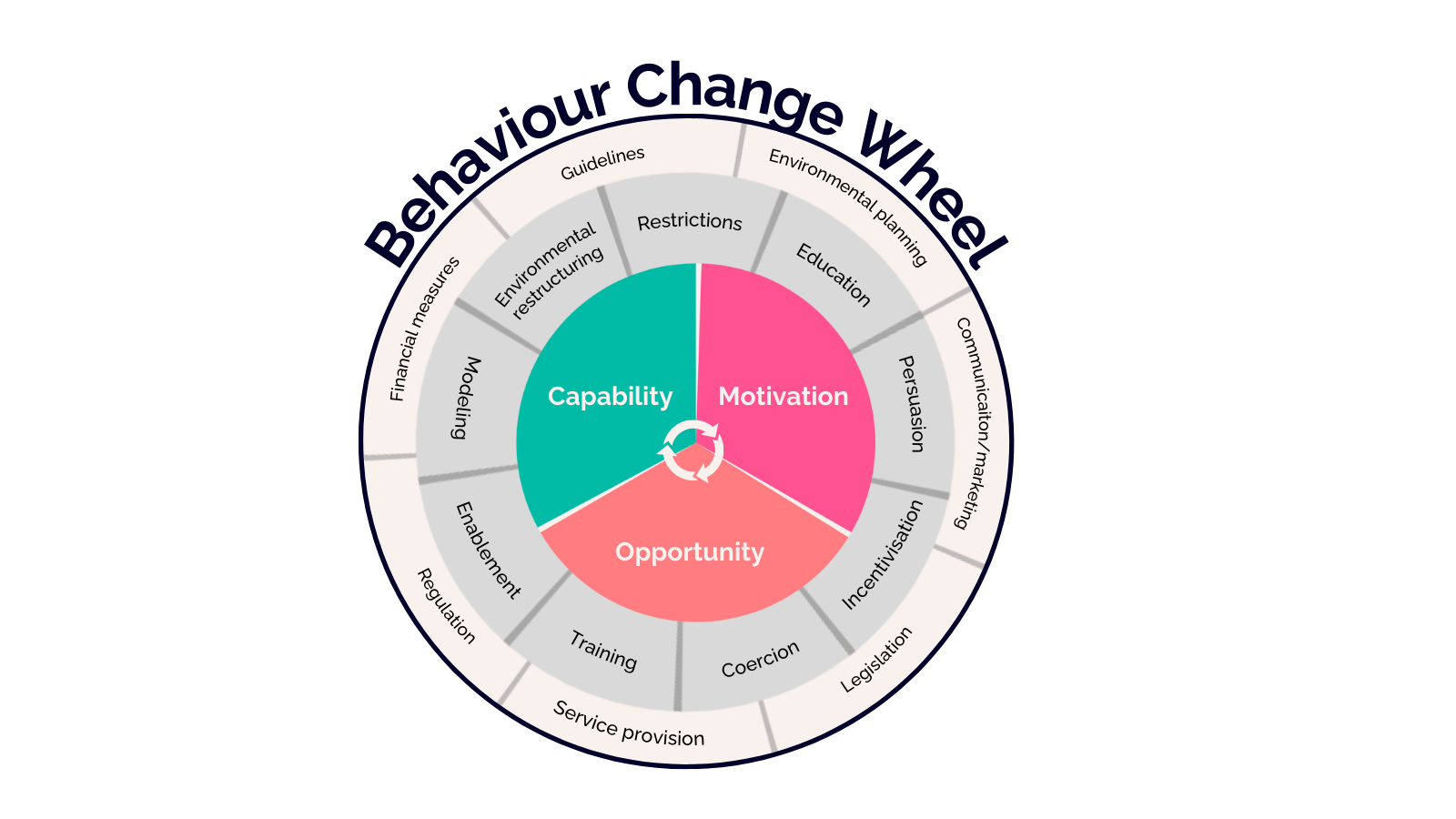
COM-B proposes that a behaviour is more likely to happen when three conditions are present:
- Capability: people have the knowledge and skills required.
- Opportunity: their physical and social environment makes the behaviour possible.
- Motivation: they have a reason, intention or impulse to do it.
These conditions interact. Behaviour then feeds back into them, strengthening or weakening someone’s skills, confidence and habits over time.
This matters for AI because access addresses only one small part of the equation. Giving someone an approved AI tool creates a form of physical opportunity. It does not establish that they can use it well, that their working environment supports its use or that changing their behaviour feels worthwhile.
Capability: can people use AI well enough to create value?
AI capability is often reduced to prompting. Teach people a formula, hand over a prompt library and wait for productivity to appear.
Prompting is one part of capability, and arguably the easiest part.
To use AI effectively at work, an employee also needs to understand the task they are trying to improve, provide relevant context, assess the quality of the response and recognise when the tool should not be used. They need enough subject knowledge to notice when an answer is plausible, polished and wrong.
The person who can produce an impressive-looking response but cannot evaluate it has access. They do not yet have capability.
That means AI education needs to go beyond demonstrating features. People need opportunities to practise with realistic work, receive feedback and develop the judgement to decide:
- whether AI is suitable for the task;
- what information the tool needs;
- what data can be shared;
- how the output should be checked;
- who remains accountable for the result.
The capability gap will vary by role. A communications team, finance function and customer service operation may use the same tool, but the knowledge required to use it safely and productively will be different.
This is why one general webinar rarely changes behaviour across an organisation. It creates awareness. Awareness is useful, but it is a long way from applied capability.
Example of enabling capability:
Edit the old artefact. Change the old templates, checklists and SOPs so the new way of working is the only described method, and cascade a clear "this is the new way of working" message alongside it. When the artefact describes the new approach, the individual no longer has to remember it, translate it into their own context, or justify it to a colleague. They can point to the document. This also ensures that companies don't end up with a collection of chaotically divergent approaches to the same problem, which happens when people are left to figure out an org-wide process individually without guidance.
This is also where customisation earns its cost. Generic training does build knowledge, yet customised education, built around the workflows people recognise and own, builds capability.
Opportunity: does the organisation make good AI use possible?
Access is part of opportunity. So are time, permissions, data, processes, leadership and the behaviour of the people around us.
An employee might know exactly how AI could improve a task and still be unable to act because:
- the approved tool cannot access the relevant information
- the process requires them to duplicate the work elsewhere
- company policy is unclear
- their manager expects the same output, produced in the same way, by the same deadline
- there is no safe route for testing a new approach
- useful examples have never been shared across the team
Research into workplace AI is beginning to show why this distinction matters. A six-month randomised field experiment involving 7,137 knowledge workers across 66 organisations found that access to generative AI changed activities individuals could alter independently, including time spent on email. It did not significantly change meeting time or produce wider shifts in the composition of people’s work. Those changes required coordination with other people and processes.
In other words, individuals can use AI to write an email faster without asking anyone’s permission. Redesigning a workflow is a different proposition.
The OECD has similarly identified skills, data maturity, uncertainty about suitable applications and the difficulty of changing established processes as recurring barriers to organisational AI adoption. Its research warns that businesses can underestimate the cultural and operational changes involved in deploying AI successfully.
Examples of enabling opportunity:
Close the old path. Once a process has been redesigned, it's time to retire the legacy report, close the request queue or remove the manual option. Someone who is fully capable and highly motivated will still take the easier route if the environment leaves it open. Removing access to one tool at the same moment another is unlocked forces the change from day one instead of allowing outdated ways of working to persist alongside the new ones.
Do note that the right sequencing conditions are highly important. Restriction only works when capability is already in place. Close the old path before people can walk the new one and you get workarounds rather than adoption.
Dedicated time. Mandate AI innovation time rather than expecting exploration to fit into people's business as usual. Time is a physical opportunity condition, and unlike enthusiasm it cannot be generated by a communications campaign and must be carved out. If leaders want people to go from what's known to discovering the unknown, giving that dedicated breathing room will shift behaviours.
Manager cadence. Embed a recurring question into 1:1s: which of your committed workflows have evolved this month? Then give individuals a route to feed value upward to the right people, in a standard format, so the information is comparable and the ROI data is impactful enough to use.
The cadence delivers two outcomes: the question is a monitoring and feedback mechanism, prompting conscious evaluation. The upward channel is social opportunity, creating a legitimate route for the behaviour to be seen. Standardisation is what makes the second job work. Without a common format you collect anecdotes which don't aggregate into ROI, and the behaviour ends up generating very sparse evidence that it worked.
Motivation: do people believe using AI is worth it?
Motivation is often mistaken for enthusiasm.
COM-B divides it into reflective motivation, such as plans, goals and beliefs about consequences, and automatic motivation, which includes emotions, impulses and habits. Someone may understand that AI could help in theory while still feeling anxious, unconvinced or more comfortable using the process they already know.
Organisations frequently make this worse by issuing two instructions at once:
Use AI because it is strategically important.
Be extremely careful because getting it wrong could cause serious harm.
Both statements may be true. Without clear boundaries and practical support, however, the safest personal response is often to keep using AI for rewriting emails and avoid anything more consequential.
Motivation is also shaped by whether employees can see a meaningful benefit. Asking someone to change a familiar process because “we need to adopt AI” offers very little. Showing them how it could remove a repetitive task, improve a decision or solve a problem they already care about gives the change a purpose.
Successful early experiences matter here. When people use AI on a relevant task, receive a useful result and know how to check it, their confidence grows. The behaviour becomes easier to repeat. When the first experience produces generic rubbish after half an hour of fighting with the tool, the feedback loop runs in the opposite direction.
Examples of enabling motivation:
Set AI team deliverables. Embed AI use cases into KPIs, such as workflows optimised per quarter. When AI use sits alongside people's tasks and is never shared with managers, most of the value stays invisible and unstructured, and the risk of unsanctioned use rises. Making it a deliverable converts an aspiration into a goal with a recurring point of review.
One caution: KPIs move reflective motivation and do nothing for capability. Introduce the target before the capability exists and people will optimise the metric rather than the work, which just induces your ROI data with biased findings.
Open sharing culture. Make it normal to share AI failures and learnings. If failure threatens job security, or attaches to a culture of blame, people will report what is safe rather than what is useful, and the costly mistakes get repeated across teams. The reverse framing is just as damaging: where AI use is read as cheating, nobody will say how they are using it.
This is a motivation problem, but not a reflective one. Fear and stigma sit in automatic motivation, the emotional and instinctive layer, and no business case or KPI will outweigh them. Where the norm punishes the target behaviour, people don't stop doing it. They stop reporting it, which corrupts every metric downstream.
Visible peer wins. Champion team breakthroughs and share them across the business. Peer demonstration works by shifting the perceived norm rather than winning the argument. People act on evidence that colleagues like them already do this. Because AI adoption is a process rather than a destination, a standing cross-departmental forum is what keeps that loop generating engagement after the initial launch push fades.
Diagnose the behaviour before choosing the intervention
COM-B is most useful when it is applied to a specific behaviour.
“Employees need to use AI more” is too vague to diagnose. A clearer behaviour might be:
Account managers use the approved AI tool to prepare a first draft of each monthly client summary, check every claim against the source data and record any corrections.
The organisation can then investigate each part of COM-B.
Capability: Do account managers know how to provide the right context, protect sensitive information and check the response?
Opportunity: Can the tool access the appropriate material? Does the workflow allow time for review? Do managers support the new process?
Motivation: Do employees believe the approach will improve their work? Are they confident that responsible experimentation will be supported? Is there any benefit to changing?
The answers determine the intervention.
A capability problem may require role-specific education, guided practice or feedback. An opportunity problem may need better governance, access to suitable data or a redesigned workflow. A motivation problem may require clearer purpose, credible examples, management support or greater psychological safety.
Another prompt library will not solve all three.
Measure behaviour and value, not access
Licence activation, login frequency and prompt volume can tell you whether a tool is being used. They cannot tell you whether that use is valuable.
A better measurement approach connects the target behaviour to a business result. Depending on the task, that could mean:
- reduced rework;
- shorter cycle times;
- improved output quality;
- fewer avoidable errors;
- better decisions;
- increased capacity;
- more time spent on higher-value work.
Even reported time savings need interrogation. Saving two hours has limited value if the same work then takes two hours to check, or if the released time disappears into a busier inbox.
AI value appears when useful behaviours become repeatable, safe and embedded in real work. That requires people who are capable, an organisation that gives them the opportunity and a reason strong enough to change what they do.
Access still matters. It simply does not finish the job.
When AI adoption stalls, the most useful question is rarely “Why aren’t people using it?”
Ask what you need them to do differently, then find out which part of COM-B is missing.
Related blog posts


.png)
.png)
.png)
.png)
.png)
.png)
.png)
.png)
.png)
.png)
.png)
.png)
.png)
.png)
.png)

.png)

Unlock the power of your data & AI
Speak with us to learn how you can embed org-wide data & AI fluency today.

