Speakers
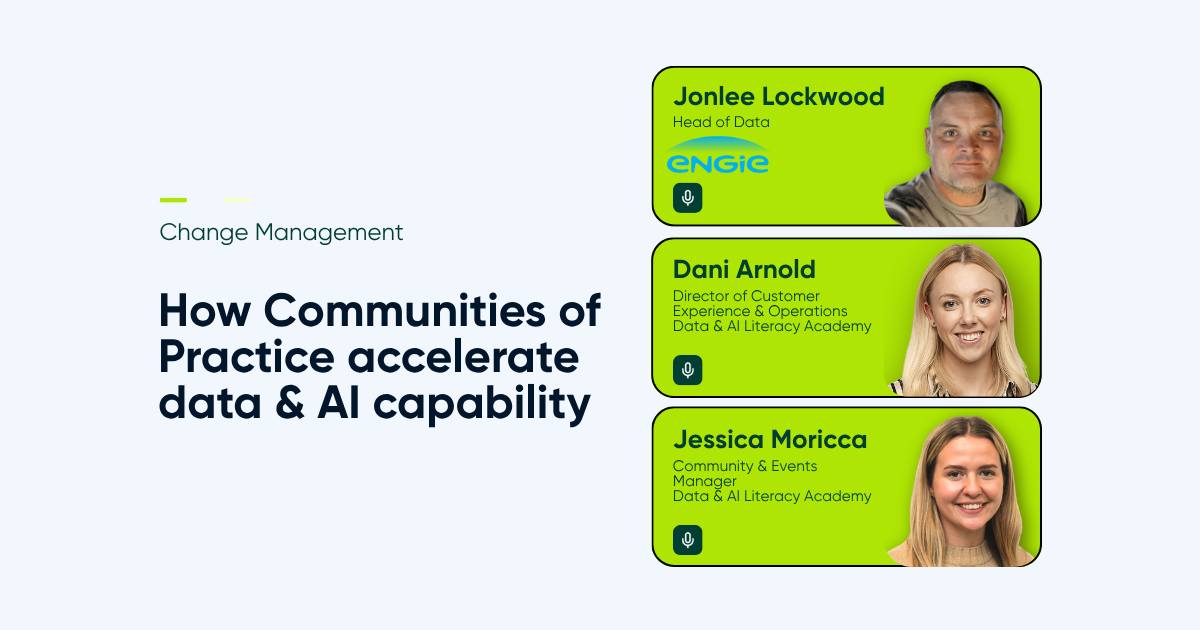
Dani Arnold, Director of Customer, Data & AI Literacy Academy
Jessica (Jess) Moricca, Communities and Events Manager, Data & AI Literacy Academy
Jonlee Lockwood, Head of Data, Engie UK
Dani Arnold: It says we're live now, so I'm going to assume we can go for it. Brilliant, I'll kick us off. Thanks, everyone, for joining us today. I hope your day's been lovely so far, or at least ends on a high with this webinar. Today we're going to be exploring our communities of practice, really, as that accelerator for data and AI capability.
With that, we're going to be covering the concept of communities generally, getting some first-hand input from a really incredible customer of ours, and sharing some advice for you to be able to implement these in your business and take some steps as you go forward.
We'll start with a very brief introduction. You can see our wonderful faces on the page, but I'll start with myself.
I'm Dani, Director of Customer.
I work really closely with our clients, like Engie and Jonlee on the screen, to deliver their programmes and make sure that what we're designing actually lands and does drive the real change that the business wants to see. As I said, I'm joined here by Jonlee and Jess today, and I will hand over to you, Jonlee, to do your introduction, if that's OK.
Jonlee Lockwood: Hi Dani, yes, thanks. So yes, I'm Jonlee Lockwood. I head up data at Engie UK. I've been heading up data functions across various organisations for around 10 years, and I've been in data for far too many decades now. I started off as a DBA, so that's my track, coming up through the technical side of things. But yeah, looking forward to discussing communities today.
Dani Arnold: Awesome, thanks, Jonlee.
Jess, do you want to take it away?
Jessica Moricca: Yeah, fantastic. So I'm Jess, Communities and Events Manager at Data & AI Literacy Academy.
I like to say I've got two sides to my role, with community at the centre of that. One of them is the communities of practice: the sessions, the actual content.
Then on the other side, I've got the learner events. So the two combine quite nicely together to create communities as a whole.
I'm going to be going into a little bit more depth today with Jonlee and Dani around communities of practice: what the purpose behind them is and what they actually are.
Then a little bit more in depth about the learner event side, so making things exciting with data escape rooms, learner events in terms of graduations and roadshows, and then just communities as a whole. But I'll pass over to Dani before I get stuck into that, to talk a little bit more about change management.
Dani Arnold: Awesome. So before we get into why you're all really here, I do just want to frame communities in the model of change that we use at Data & AI Literacy Academy. We follow the ADKAR change model.
ADKAR, as you can see on the screen, covers the five stages that an individual moves through as they process change. As you can see here, it's awareness, desire, knowledge, ability and reinforcement.
In theory it's simple, it does what it says on the tin, but if you do skip a stage, we do tend to see that the change doesn't necessarily hold.
We'll start with awareness, and that's about people really understanding the change that is happening and, probably more importantly, why the change is happening to them. That's followed by desire, which is the individual's personal motivation to engage with the change or actually process that change. So really, the "what's in it for them".
Those two are foundational. They're not a skill; they are a mindset and a behaviour as a starting point.
Once you move through awareness and desire, you land in knowledge, and that's the actual learning: the content, the how-to.
Then you follow into ability, and that's really the practical capability to apply the knowledge in the day to day. Does their role allow them to apply the change? What's different for them?
To cover the third and fourth markers, knowledge, ironically, is the knowing and ability is the doing. They are treated separately: there are different conditions, it's a different environment.
We end on reinforcement in the ADKAR model, and that really is about making the change stick once the training has ended. Without that, ADKAR tells us that people can slowly drift back into old behaviours, no matter how good the first four stages are and how much effort you've put into them. If it's not reinforced, if something hasn't changed for them to really use the behaviours and the skills we've given them, they will move back into the old status quo.
Reinforcement is how you make change scalable, it's how it's sustained, and it's where communities fit in. It's a fantastic lever for this. So hopefully that paints a picture of why we're speaking about communities today, but I'm going to hand over to Jess, who will paint that picture, and Jonlee will layer on top of that with it actually being a real-world example.
So Jess, over to you.
Jessica Moricca: Great, thanks, Dani. I think a good starting point from that is what communities of practice actually are, and what the sessions actually entail.
Communities of practice sessions are designed essentially to keep momentum going, right? To keep momentum, boost engagement and bring the cohort back together during the down months of learning.
In that sense, the programme, and Data & AI Literacy Academy, acts as that catalyst to kickstart communities and support clients with their communities of practice.
As I've mentioned in previous sessions when it comes to communities, we join clients where they're already at. With Jonlee, there was already a community of practice in place, and it's definitely something that's been in conversation with yourself and with Engie. But it's the case that we actually meet them where they're already at: are you starting from scratch, or do you already have a self-sufficient data and AI community of practice? I don't want to jump from left to right here, because I've just jumped onto the right-hand side of the life cycle there. But in terms of what the community of practice sessions actually entail, we talk through what the purpose is and the importance of communities.
We celebrate achievements and we showcase learner demonstrations. We get people to stand up and say, "I've done this this month based off the learning. I've saved X amount of time from solving this problem, and this is how the programme has supported me through that."
We go through highlights from the programme and the impacts from the modules. We also hand out awards, which is actually something we did quite heavily with Jonlee and Engie.
But the main part is that we talk about the real business problems, right? Making sure that people are at the centre of community and that this isn't just a programme that's being forced down people's throats. They're actually supporting the education and learning from it, but also changing the business at the same time.
That being said, I think that's where a lot of things come out of most of the sessions. You know, as Brits, we like to complain about a lot of things, but when people are given the space, the opportunity and the environment to say openly and honestly how they feel about things, that's when they take the opportunity to actually say, "This isn't working, and this maybe isn't working either."
Specifically with Engie as well, one of the main things was that this was the opportunity for people to close feedback loops. In quite a lot of the sessions that we did, someone would say something like, "I can't get access to this or that," and Jonlee would just say, "I'm going to stop you right there, because we're already working on that," or "We've already solved that problem."
But yeah, that's the premise of community sessions. I don't know if you want to add anything there, Jonlee, specifically about what we did in those sessions and how that went as a process in general.
Jonlee Lockwood: Yeah, I think you've covered it quite well. The other thing to add as well is what we've started to do is, you know, "bring your successes" to the meetings. It's not about a single statement or an initiative; it's actually bringing the people that you helped. So yeah, bringing people to those meetings I thought really helped with the engagement and the recognition. Yes, it's all good that we have financial recognition or award ceremonies, but, you know, for me, the way I like to operate is to recognise, see that recognition, see that change happening. So yeah, we evolved that. We didn't do that in the early days, but we felt, through the second parts of the engagement, it really, really drove home that sense of achievement.
Jessica Moricca: Yeah, I think definitely, in this instance, it was potentially slightly easier because you already had that group, that champions group, already situated. But I do know that we gave you some more from the programme. There were a couple of learners where we said, "I think they should join the community sessions," and the champions community specifically, because they had been saying some fantastic things in the programme. They'd been talking about different activities they'd been doing.
It's that narrative between the programme and the communities, which is quite a nice tie. You might not be able to see everything everyone is doing all of the time, but we have that lens into it, where we can say, "Oh, actually, we can see what people are saying, what they're doing and how they're improving, and this person is clearly a real champion for the programme," and therefore we can give them to you. So I definitely think the awards were such a fantastic thing. I'll go into a little bit more depth on the next slide about motivation, but handing out monetary vouchers to people is definitely a motivation for getting them to stay engaged. I know I would also feel that way about it.
I'll step onto the next slide there, just because it fits quite nicely, to talk a little bit more about the purpose.
I like to see this through two lenses. The first is the company's purpose: why would you, as a company, have these community sessions, have these champions committees, and grow that?
And that being to develop future leaders. I think that's definitely the key one, the second one there. Whether that's people you might not recognise, or who maybe don't even have the title of someone more senior, being able to see that and have that view within these sessions, and us supporting you with that, is definitely something I think is key to pushing programmes like ours, but also internal data and AI strategies as well.
Also the breaking down of silos. Within the champions committee, we've got people from different angles of the business. And I know we mentioned before, about phase two, getting more champions on board: can they be from different parts of the business as well? Connecting them and bringing them together, it might be the case that people are facing similar challenges, and actually that's a thing that people need to face, and that's why these sessions are put together.
The fourth one there on the right-hand side is the learning and the ROI, definitely for the company. But actually, the flip side is the individual. Why should an individual come to the community of practice sessions? Why should they even be there in the first place? They're very busy people. They might be thinking, "I haven't got half an hour or an hour to come to these sessions."
I like to see it through two different lenses: you've got your intrinsic and your extrinsic motivation. So that's the prize giving, the award giving, the kudos. Then some people are motivated by standing up and saying, "I've actually saved 100 hours of work this week. I've saved the company X amount of money."
Obviously, what that might be differs depending on the company. Some people might be motivated just by supporting the company in general, trying to solve problems and that kind of thing.
But by seeing why people would come and linking that to the purpose, you're able to angle communities of practice in different ways. I know that's definitely something you've targeted, Jonlee, through the awards and going through different lenses.
Dani, I know you know a lot about incentives and that kind of thing. I don't know if there's anything you want to add on top of that. I know I just went on a massive tangent just then, but...
Dani Arnold: No, I think, from the point of view of what's driving the individual to see the value, but also the bigger picture, it helps tying these to individuals' objectives. It's not just side of desk; it's getting that sense of purpose. And I know, Jonlee, that champion network at the start really wasn't just side of desk; it was really seen as an enabler to the business. How did you start with that initial purpose in the community, the first one at Engie? What was the reason and the purpose for that one to get going?
Jonlee Lockwood: Well, we started the programme slightly differently to how I think a lot of organisations would start, because we had a clear ask: we wanted to get some form of ownership, some sort of stewardship.
I felt that some of the key aspects of setting up those communities were that we needed to get out to the wider organisation, right? Data, for me, is everywhere. Everybody says that they understand data, but what we did with the communities, when we went out and engaged, is we got people who were excited about data. And I know this sounds a little bit cheesy, but they are everywhere, right? You've got your finance people doing Excel, you've got people tinkering, and with webcasts like this being spread around LinkedIn, you really start to drive home that you have got that sense of people out there in the communities.
We did have some challenges, to go off on a slight tangent, in getting there, because, as you said there, Dani, it can be side of desk. But we created, I guess, a sense of a vision of what we wanted to get out of a short-term window, and that was education. We helped with the education as well. It wasn't just about "You're a champion, thank you." We got them into workshops. Data & AI Literacy Academy designed the workshops specifically with that value in mind.
Then we were trying to set short-term goals for everybody. So yeah, I did ramble on a little bit, but it was a challenge to start with. Through the engagement, and really adding value to what we were trying to do, or for us to articulate what the value was, it really brought a sense of community to those individuals.
Jessica Moricca [CHECK: speaker; could be Dani]: I don't want to jump ahead of the script here, but I know Carwin [CHECK: name as transcribed; confirm], Customer Success and Delivery Manager at Data & AI Literacy Academy, that was a mouthful, mentioned you'd been bringing champions in to support with success metrics, the actual programme itself and getting feedback.
Could you tell us a little bit more about that, and what you've been doing with them?
Jonlee Lockwood: Oh yeah, that's a tough one, because a lot of these things around training and education can be quite subjective. So what we've tried to do is work with the communities and wider people. We've just done, we did quite a big workshop with the executive on what some of those successes could look like. A lot of it's around engagement, and around some of the finer-grained ones, which are not necessarily to do with the community but with the overall programme.
That's people's participation, whether that be in the education or the events that we're going to start to do, because we're starting to talk about, "Let's have a data event, let's have a summer bash," to keep not just the community engaged, but the wider organisation that we're trying to bring on the journey of data literacy. It's interesting, some of them, because they were very subjective. But how we're aligning to data quality, that was a massive theme from our executive, and I think everybody listening to the call will say that they don't have perfect data.
So we're trying to attribute and put some lineage or tracking on data quality as well. There are some factual things that we can do, but also the timeliness of how we bring those to the relevant committees and relevant forums that we've got within Engie.
Jessica Moricca: Yeah, that's fantastic. With the champions committee, it's about growing that, right, and finding those new people, and being able to support those decisions, which is really fantastic. The challenge is getting them, finding them and growing that in the first place, but once you get there, it's about making that meaningful change and making that route down to what you were just mentioning previously.
Dani Arnold: I'll just interject that I think what you're doing really well, Jonlee, with those champions in the network you started with, as your programme's evolving and growing, which is brilliant, is using them to input into the next round. It's giving them that sense of contribution and ownership in the direction going forward, and that ripples as people speak to each other, especially in a community: "OK, you can come to this and you can shape the change that you may be doing [CHECK: possibly "going through"]." The frustrations you feel, the friction. So it's a full-circle moment in what you're doing there. I think it's really well done.
Jonlee Lockwood: Yeah, and the one thing that they don't know about yet, because I guess I'm breaking the news now, is what we did on phase one. The one good thing about the education piece that we do with you guys is that we customise the learning. There's a lot of time and effort from both parties in customising it, whether it be certain data references or terminology and things like that. What we're going to be doing with some of the champions is bringing them into those customisation pieces as well. We've got quite a big segment of Data for Business Professional and Data for Business.
So they're going to be helping shape those cohorts of education as well. We're making them feel more engaged with the programme, and one of the champions is also helping shape the project as well. So it's not just a traditional data initiative; it's a full business initiative.
Jessica Moricca: Yeah, that's really fantastic. In the community sessions as well, we did quite a few feedback bits, so it's great to see that just explode, I guess, in that sense. The learners are at the heart and centre of the education, and therefore they should have a say in what journey they're taking on. So it's great to see that approach being taken forward.
I'll move on to the next slide, just to cover a little bit more about what we can offer and what we've also done with our other clients. We've been very close with Jonlee on the champions community, but a lot of our other clients also need support setting up governance committees [CHECK: transcribed as "governs committees"]. One of our clients set one up completely from scratch, and it's now growing and it's part of their strategy.
We also do a data stewards and data owners community. That's about empowering those data stewards and data owners to showcase their data sets, what they're doing to change them and how they're improving them. We make it a little bit more accountability based, which I think is important, but we also celebrate those wins and we connect those people. I guess it's a caveat and an offshoot of the communities of practice, and very similar in concept. But it's just nice to know that there are different angles you can take with communities. It's not just the champions community, which is fantastic and such a driver for business; there's also so much more you can do with communities.
To make it, yes, cohort specific, but actually to grow that, make it community specific, make it company-wide specific, sorry. Especially with the communities of practice, that's something you can really grow and not just make it that niche driver. You can make it, "Oh, let's find out a little bit more this week. I've got an hour free at lunchtime to find out a little bit more about what someone's doing with a dashboard," or something along those lines. So it's about that growth and that sustainability.
At Data & AI Literacy Academy, we support our clients with that alumni community. When the programme finishes, when the learning finishes, it's not about "Oh, that's it". It's about continuous growth and seeing the change over time, because realistically we're potentially not going to see everything as soon as a lesson ends. It's about that growth and seeing that as time goes on.
I'll just move on to the next one, so all the fun stuff. Dani and I love going to the events, which is great, as you can see from us on the right-hand side there. Community is so much more than just communities of practice sessions, and those are designed to be slightly informal, so that you can be open and honest and have those challenges. But actually, community is about the graduation, it's about the roadshow events. We've started doing data escape rooms. I'm actually doing one just after this session today. Hackathons, challenges and Data Literacy assessment drives , so that's where Dani and I were, up on the right-hand side there.
So that's the gamification element.
Actually, in a lot of our community sessions with our clients now, let's say we do them on a bimonthly or a monthly basis, one month we might do a 30-minute data escape room, and then the next month we make it specifically about challenges. The next month might be a graduation to finish the cohort up.
So it's about keeping that engagement piece going, making it fun and having that gamification element to it.
I know we were meant to have an event with Engie, but it's definitely something on the cards, I think, Jonlee, to get that engagement piece going, that in-person element.
These are just a couple of the things we can do, and the options are endless. Keep the challenges going. I'm still trying to come up with different concepts and be creative, so I'm open to anything in that respect.
Dani Arnold: Yeah, that's a nice stepping stone, actually, to the next question I was going to ask Jonlee. When it comes to the momentum and making behaviour change, or helping communities actually drive the behaviour change you want to see, how is Engie approaching that, with everything Jess has just mentioned there and all the varieties of engagement that you can go through?
Jonlee Lockwood: Oh yeah. So we've got the communities, which I think is great, and as I said, we've talked about some of the key aspects of having data days and those kinds of things. Because what, you know, the teams themselves, and let's take the traditional IT teams and the data teams, we've got vast amounts of knowledge and technical skills, and more and more now, people around the business are also catching up with those skills.
So what we're trying to do is engage through those communities to harness those. For me, that's how we're driving that change: we're seeing these people as advocates to get to insights faster, better data quality and everything else, and it's not seen as a central piece.
I think that's massively important to get that engagement. So we're doing a lot of those. Could we do more? Absolutely. We simply don't have the time at the moment, but we've definitely got things on the roadmap where we will be doing those kinds of initiatives.
One thing that we've decided to do, and this is not because you guys also include artificial intelligence, or AI, in your name: we did have other communities, and we've joined them together because we've seen that there's very much a likeness, and we wanted to streamline the communities that are out there. That's actually brought data professionals together with business representatives, where we're getting more and more AI, because that's the big thing at the moment. How can we save, how can we be more efficient, how can we drive change? It's all through data for AI, and guess what? Good data, or AI needs good data. So that's what we're trying to bring into those levels of communities as well.
I guess to answer the final part, of what we had to unlearn, with the initial training, for me, you're generally told that, you know, the idea is that once you've been told something, you know about it.
The big thing that sold me on Data & AI Literacy Academy, I will get there eventually, is that Greg always said it's about repetition. I think that's been the key value for me in these things. It's not just about giving them education. We're going to be constantly doing these things, constantly doing on-demand training, constantly hitting data owners, data leaders, data stewards, communities and the wider piece of individuals through the various mechanisms and communities that we have.
Dani Arnold: Yeah, and I think, as you've touched upon, there's a lot of time and effort that goes into doing that. As you said, for people turning up, you've got to show the investment and the value to them. I think evidencing value, especially when it comes to literacy, cultural change and behaviour change, is very hard to quantify. So when it comes to Engie accepting and growing that community base, how have you had to navigate the upward awareness of the value that they bring, and also, for the people participating, why they should turn up? What have you put in place, and what's been more of an organic catalyst?
Jonlee Lockwood: Upwards to leadership: I think at the beginning of the call I mentioned that we structured the first phase of the programme slightly differently, where we engaged with leadership first.
We did a big education piece around what we call Data for Leaders. It's part of your portfolio, I would imagine you know that, but for others. So we really drove home and had some really good engagement through the leadership element. We had a mixture of executive people on there, we had heads of, directors of, management and team leaders. So we were starting from the top, and with the communities element we were also starting within the business, so that hopefully, when the community people start discussing with leaders and others, they're all aligned. The practice wasn't anything unusual. I just thought it worked really well, because sometimes you have to start from different angles: get the exec in, and others.
So it wasn't very difficult, I don't think. It just became more effective in how we engaged with leadership first, and they just got it and they were aware. What that meant was that they would then dedicate more time. Let's say they said, "Oh well, we've got a workshop for a few hours with Data Literacy Academy." "Yeah, great. We're all bought into this." So it drove those kinds of behaviours right from the top. Without that, I think it's like any change in any organisation, and it doesn't have to be data literacy: you've got to have that buy-in from the top.
Dani Arnold: Yeah, definitely. And sometimes timing isn't perfect, is it? You can't always go leadership first and then have that follow. One of them has got to start before the other can take momentum, but it was great that they lined up for you.
Jonlee Lockwood: Perfect. Yeah, and it's the behaviours, right? What people started to see, and this is what we discussed with the communities when we first started out, is that behavioural aspect, and we can show that they're confident, because that's the big thing about the programme: it's making people data confident. It's not necessarily just about fixing the data; it's about understanding how to challenge it as well.
Jessica Moricca: Yeah, I was just going to add as well that I think it was the first community session, when I came back in to support them and kickstart them going again, that I remember someone specifically saying they'd noticed the drip-feeding effect.
I think that sums up what you were just talking about, me with my great memory remembering that. But I think it really sums up the whole thing: they were seeing that definitions were being used by people who weren't even on the programme.
I think Engie specifically has that culture where they want to learn more, and it really shows in this community of practice, where someone has actively said, "Oh, I can actually see that in people who haven't even done any learning yet, this effect is beginning to start and the change is beginning to come about." And I think it definitely helps when you have an exec team and heads of who are just as keen. It's when they're not that the challenges start to come. Being able to feed back everything that has been said across the programme to the execs just fuels and excites them as well, and I think that's definitely part of that process.
Jonlee Lockwood: I will say that the champions and the communities are probably just as, if not more, important, because what I realised quite early on is that if you've got people in these communities who are generally people within all the different teams, and they're talking about how good this is and how excited they are, then that excitement spreads, right? It's like a virus spreading, but you want that positive. Rather than "OK, yeah, it's just another online training course that we've got to do, we're mandated to do", they talk about how exciting it is, the value and the change, and there's less of a change burden on them.
Jessica Moricca: Yeah, definitely. I'm moving on to this slide here, but I think the centre section there, clear ownership... Not to toot your own horn, Jonlee, but I think it really, really helps when there's a stakeholder pushing the programme as much as you do.
When someone knows what the vision is, knows the strategy and knows the business inside out, it just makes communities, change management and culture change in general so much easier. If you left tomorrow, let's say, they would probably struggle. I think they would. I think it's about having that headstrong person to be able to deliver a programme and be the spokesperson for it. And now, because of those communities of practice and the champions committee, you've grown, and we've empowered this different group of people to push that forward. So I definitely think that middle section, clear ownership, is really, really key to having a data and AI community of practice, and to the culture piece in general. And then having that regular engagement. I know it's difficult, and we've had meetings before where you've mentioned, "I just don't have the capacity at the moment." It's about still acknowledging its importance and picking it back up when it's needed.
I definitely think the champions themselves could probably be self-sufficient and push that on, targeting a couple of people to even just book the meetings. I think that's also part of it: taking that pressure off yourself, as someone who's slightly more senior, and giving it back to those who are within the education, saying, "OK, you're now in charge of this. I'm going to come and push it along."
And having that wider group that isn't just one or two people. It's actually 20, or maybe more.
The active communication part, so I'm going middle to left, and then I'm going to go right. The active communication part is the comms pieces, the internal Teams channels. I know a lot of our clients have Viva Engage.
We can now support with that: I can actually be dropped into Viva Engage channels and Teams channels to do updates and polls, as an engagement step from our side.
And I know we've supported you with comms and that side of things as well. That's definitely something I think is super important: making sure we get those blogs out, highlight, do the kudos, hand out those awards, and make sure that's company-wide so names can get mentioned for how fantastic they've been doing on the programme, but also the supportive nature of the committee as well.
I guess in that sense it brings us to collaborative learning, right? You get to learn from each other in these sessions, and part of this aspect is that it is self-sustaining over time: you learn, you ask questions, even when the programme has finished. That moves on to the inclusive and thriving aspect. Anyone can come, not so much to the champions committee, but obviously, if you're a champion for the programme, and for data and AI, get them involved 100%.
But it's about solving problems as well, and keeping that thriving element.
Dani, I don't know if you want to add anything to that aspect.
Dani Arnold: Yeah, and I think it touches on what you mentioned at the start about ownership, and how communities do become self-sustaining in their own right when they start to flourish and have momentum, because you get people who really want to move this forward. You've got Jonlee: as you said, you are senior, you are very busy, and you can step out of this and you've got a trusted network that can move the strategy forward.
Some of the indirect ingredients and successes we do see: we'll be hosting a community and you'll see in the chat that people are talking, troubleshooting, solutionising, discussing taking it offline and then meeting to really put business problems to rest, collaborating across different parts of the business. If we didn't have that forum for them, would that sit in isolation? Would it sit and fester? So there are those indirect successes that we see after that. And I guess, are there any ingredients you see missing there, Jonlee, or any sprinkles Engie puts on top of that?
Jonlee Lockwood: No, I think, you know, thanks, Jess, at the beginning for the kudos, but I'm quite lucky that my executive director and others across that, I guess, top table are bought into this as well. They see the value. They've had challenges for years, right, OK, so that's why I was brought in 18 months ago.
They see the value in that, and they see that they need to make that investment, not just in me but also in the teams, whether that be time or their own initiatives and things like that that help bring that value. So I'm lucky that I've got that support, and I appreciate that other people listening to this may not have that, but you have to keep being persistent in these things, because the value, all those ingredients that you want to build up this, I guess, community cake, is important. And I did learn early on that you can't take the burden yourself. So yes, as Jess said, sometimes you are too busy.
But that's why, once you create a repetitive process, anybody should know what that process is, just like anything. So definitely getting those and sharing it, and I guess not wanting to take all the accountability yourself. Although you're driving the programme, that's why I said I'm bringing other people from other areas of the business into designing the programme, because then if I can't make it to one of those sessions, they're driving it just as much, with the same narrative and the same vision as well.
Dani Arnold: Yeah, absolutely. You did mention a very nice point there about not everybody having the infrastructure you've mentioned. We've spoken about quite a lot of the successes, but this isn't easy. We're not saying this has happened overnight. There's been a lot of time, effort and investment, and, as it says here, there have been parts where you've had to reinvigorate engagement.
Where have you had to step in to do that, or maybe pull us in to do that, and what have you learned from that for the future?
Jonlee Lockwood: Yeah. I've learned, for me, going back maybe a year now, that many years ago a lot of these initiatives came from IT, and a lot of data functions now are taking that sideways step out of traditional IT.
I think that's what's been important for me: although I love my IT colleagues, having that separation to say, "Look, we're going to drive this, and we're going to take IT on that journey," with some of the, whether it be artificial intelligence, and they're enablers as well, so we're driving those.
So it's always looking at how we can help people do better within those things. Driving the momentum has been a challenge at times, but I do believe that those communities did bring the energy. And that energy can come in waves, I get that, with people's holidays and people not being in the office. But we tried, on the second phase, and I'll give you kudos, Jess: Jess coming into the programme really brought that sense of engagement back. Having that mindset change as well has been able to bring back some of those key drivers of why.
We also did a session not so long ago, because we did feel that the communities were going up and down, so we went back and said, "Right, OK, what's our vision? Who are you engaging with? Bring your successes [CHECK: transcribed as "successors" again] to the meetings." And that gave us a refreshed format. We talked earlier about bringing a buddy, and everything else, and re-bringing the awareness campaigns as well. So there's a lot. I think I've discussed quite a lot there. Are there any questions on that one, Dani?
Dani Arnold: No, I think that reinvigoration, I guess, is almost having to buy back their incentive, the what's in it for them, and it leads very nicely to the next one.
We didn't even script this, guys [CHECK: transcribed as "Didn't even script this guy. Saying who's watching this quite organic"; meaning inferred]. For whoever's watching, this is quite organic. But they do have to see it as an opportunity, don't they, not an extra burden. So how have you brought them back into that? Because you do have to continuously check, and as Greg mentions, it's iteration, iteration, over and over again. How have you brought that back into the fold, so that they see this as a benefit and not an extra burden when it does need to be pulled up again?
Jonlee Lockwood: Everybody says this, but I think it's showing what their value is: giving the champions the means and the tools, or the awareness, and, I guess, the unified vision of how we do those.
I think in the early days they did see it as a burden, let's be honest. It's like telling somebody, "Oh, right, you're going to be a data owner." "Oh, OK." But when they actually see the value of what that can be longer term, and how close they get... One of the things I try to say to people is that when they start to engage, they become known. When we talk to these people, we say, "OK, you actually know lots within this area, and you can help us out in another." And it gives them that sense of appreciation, that they've brought something to the table and then been able to see it through.
So I think giving them that level of ownership and accountability really drove that engagement, for me.
Jessica Moricca: Yeah, I guess that's the motivation piece, right? Why do people run marathons? Why are they going to attend this meeting when they're really busy? Everyone's motivated from different angles. As you mentioned, some people are motivated by the good things they're doing and being able to help and support, and then some people are motivated slightly differently. So it's good to see that angle being hit, and that does support the engagement.
As you mentioned, it's difficult. It's probably one of the most difficult things, keeping people who are already very busy engaged in something that doesn't directly relate to them. But I guess that's the culture change, right? And the passion that you bring to the sessions makes people go, "Oh, but I actually probably should care about this, and this is why."
But yeah, definitely.
Jonlee Lockwood: Yeah, and we wanted to make it clear as well that we weren't creating a dumping ground. I think we discussed this in one of the community sessions. We didn't want to create a dumping ground for data problems to go to these, because we'd lose them. They'd just be like, "Oh, oh, somebody's coming to bring me [CHECK: transcribed as "00, somebody's coming to win me"] the 50 data quality problems and I don't know where to go." So we have those conversations and have those early insights into how we can drive those.
I believe that when we originally got the communities together and the champions together, those workshops that your team ran really, really helped. I think that brought them into the single view of what we're trying to do, to collaborate with one another and get to know who the champion is in operations, or within sales, or within billing and collections and things like that. So you get to know those as well.
Dani Arnold: Yeah, definitely. There's a lot of motivation in that point, but you've already touched on exposure: awareness in the business, internal PR for this. That is one of the benefits of starting to go to communities as they grow over time.
So I think that takes us quite nicely on to a bit of a wrap-up point. A lot of these things have been discussed, but what's important here is some of the tangible next steps if you're setting up, or keen to set up, your community internally, some of the frictions that we consistently see, which Jess and Jonlee have both spoken to, and some of the solutions you can start to put in place. You don't have to have the perfect environment to start a community.
We hear a lot of "I'm part of a community; what am I supposed to do? I've been nominated, and what's even expected of me?" Some of those things can be quite simple. There can be ready-made toolkits, a bit of clarity around talking points, micro-learning, or just some quips to send in there, and that really does set a bit of a structure. People like to know what they're going in for, and once you've gone in once, that comfort is there, a little bit more confidence comes from it, and you start to get exposure.
So give it a bit of structure as a starting point.
We also hear a lot of "Really great idea, don't have time." That's probably the one we hear most, if anything. We spoke before, and Jonlee just mentioned, about how he really got support from the exec and leadership at Engie. But it's getting that management sponsorship of the individual, showing the manager what's in it for them and other team advocacy, or getting it into OKRs, getting it into objectives. We don't want heroics from these individuals. We don't want it side of desk or just goodwill. We want them to feel empowered, and that the business is really taking this seriously, that they're contributing and they're helping their development at the same time.
The last part, which I think links to that if you go from an objective or OKR perspective, is "What's in it for me? I've got all these things to do. Why am I going to turn up?" That's about evidencing that communities do bring value to what they care about. And what do people care about most? Less doing the same thing, less time spent on stuff that's broken, faster decisions, solutionising in shared experiences. Not the dumping ground Jonlee mentioned, but really productive conversations. That's what this is about: those shared, concrete, named wins.
These are known challenges. I think I saw Jonlee nodding his [CHECK: transcribed as "her"] head quite severely there. But hopefully that puts a few things in place that you can take off as a next step, and it leaves us with a nice chunk of time for some Q&A. Before we do that, Jonlee, are there any other frictions around there, quite categorically [CHECK: phrase unclear as transcribed], that you can share any solutions for?
Jonlee Lockwood: Oh, I don't know about solutions. As you may have figured, it wasn't easy to start with, right? A lot of it's new.
I think historically, if you've worked in IT or an organisation, these kinds of communities are very much like centres of excellence, but not for a technical approach as such. So think about it like that. There's plenty of research and help out there around centre of excellence models, but the Data Literacy guys have put a completely different spin on the communities, which is massively positive and has worked well for us. For me, just like any data person or leadership, and it doesn't have to be a data person: stay engaged, stay positive. There have been many nights where I've gone, "This is tough, I don't know what the answers are," but you talk through it. Luckily I had good peers. I've got a good network within the organisation, one of whom I can see is on the call, because I've seen the chat, and I've been sounding out [CHECK: transcribed as "soundbiting"] some of those people about what they would do. Typical kind of question.
I don't know all the answers, is what I'm saying. So use your network. If you're already engaged with Dani and Jess, use them as well. They're very good people to talk to, and even if they haven't got the answers, you can work together and curate the right way forward.
Dani Arnold: Yeah, fantastic. We've got a question which I'm going to send back to you, Jonlee, actually, as the expert setting this up, and there are a few questions in one. One is: what is your target audience? Is it self-serve type roles, or is it for everyone who goes through the learning, and do you treat them differently?
Jonlee Lockwood: Is this for the community or general?
Dani Arnold: I'd say community. Start with community, and we'll see if Francis [CHECK: name as transcribed; possibly Jess] wants to add on any of that.
Jonlee Lockwood: Yeah, sure. For me, the target audience for the community, I originally pitched this at the people who are actually doing the hard work, right, the people in the systems seeing the problems. But we did put it out there, and we've got a mixture of senior management really engaging with data, and they've got a passion for data, which was great. So we had a mixture. I'd say there's no target audience. I think you do want your people who are really challenged and have a lot of the data challenges, whether it be quality, process or anything like that.
So it could be anybody in terms of the target audience, but I would definitely side towards the people who are doing the hard work, and not the ones just doing webcasts.
Jessica Moricca: Yeah, as I think we mentioned previously in the webinar, we gave you some more people who we thought should join the community. I guess that's how we can support: we can actively say, "This person seems really engaged. Let's reach out to them and ask, would you be interested?" And I think two [CHECK: transcribed as "to"; possibly "two"] then joined because of that. So yeah, as Jonlee mentioned, it is open floor in that respect, and I don't think it should be exclusive. Anyone who's interested, from high to low, across the whole business, marketing, finance, sales, anyone who is passionate about it, should have access to it. It should definitely not be an exclusive thing at all.
Jonlee Lockwood: No, and it's good that you have that variation. To your point, Jess, I think there's definitely a sense that everybody has problems, right? And sometimes it's good, and I'm not going to use the analogy on a live webcast that I'd use normally, but it's good to have leadership and people, because guess what, they can make the decision and act. So you've got somebody who has the problem, and somebody who can make the decision to change a process or data or whatever it might be.
It gets done, and it's autonomous at that point, and then you're not having to go through "Well, I need to speak to this data owner or that one." They're in that community, they're in those ways of working, which is massively positive for us.
Dani Arnold: Yeah, absolutely. And a great question around: if you were to do it again, what would you do differently?
Jonlee Lockwood: Great question. Great question. Let me just ponder on that one. So, I think I mentioned earlier, we did it in two phases.
I think that was the right thing at the time. Looking back now, I probably would have done the full phase of the programme, and see the website for what those are. But that's more that we got the engagement from exec, but we didn't run some workshops and we didn't do these kinds of things.
The bit that I really value, and I'm going to give him kudos again, is that on the second phase we brought more business people into the project to design the project and have those weekly calls with us, shaping the challenges and how we get better engagement outside of the community. So this is shaping the project and the delivery, whether it be the education in the community. Having those people there, people who know the business better than I do, is only sort of seen there. So I wish I'd done that earlier. I think it was Claire who asked that question. And really get that, because as a head of data, you think you know everything about data, but you don't. So you've got to seek that help out there and get that engagement, and it also acts as a "yep, we're engaged".
Pick the departments that sometimes, not Lucas, not that this is you, pick the departments that are sometimes the most challenging to engage with, right? Not challenging, but sometimes resistant to change, right? Because that will then give you your advocate, your person who's going to start to talk more, and that's where your communities come in as well.
Dani Arnold: Absolutely. Yeah, fantastic, brilliant.
Wonderful. Well, I guess this isn't the end of this conversation. If anybody on the live does want to speak to us about it, as Jonlee mentioned, we're all on LinkedIn, or drop us an email at the address you got this invite from. I hope you've enjoyed the chat today. It's been great to actually work through it with you, Jonlee, and talk about successes and challenges and really pull it apart for people to take some learnings from.
Jonlee Lockwood: No, it's been good. And I've finally broken my... this is my first webcast, if you hadn't known, because everything was falling over. So I appreciate you staying with us. It's been fun.
Dani Arnold: Great, love it. I'm sure our marketing team will be bringing you in for some more on that feedback, then.
Jonlee Lockwood: I had to buy a mic for this, so it'll cost me a fortune for a proper setup now.
Jessica Moricca: Got to get some ROI out of that purchase.
Dani Arnold: Thank you, thank you so much. Have a fabulous rest of your day. Speak to you soon.