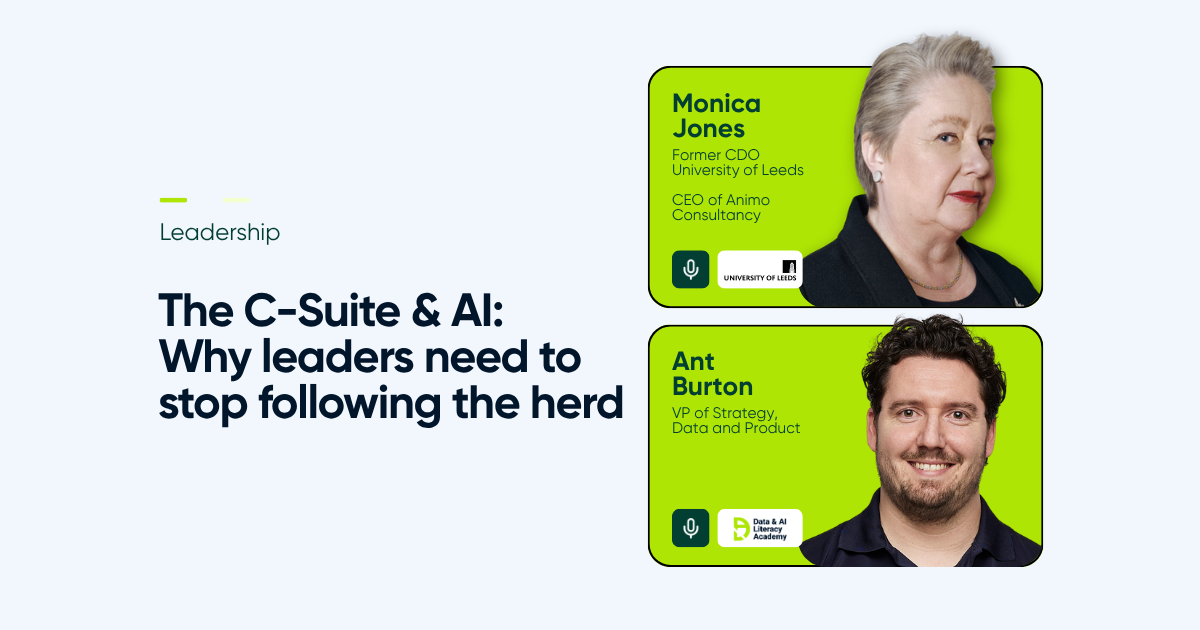
Ant Burton: Welcome everybody. My name's Anthony Burton, and I'll be hosting today's session with Monica Jones. I'll hand over to Monica very shortly for an introduction, but today's session is all about the C-suite and AI and why leaders need to stop following the herd, and on that note, I thought I'd start with a little story.
Many of you in the room have probably heard of the frontier AI research group called METR.
Well, they ran an interesting randomised trial with some very experienced software developers, and they're all real tasks, so it's all their own projects, and half did it with AI, half did it without.
And the group who did it with AI, so same conceptual tasks, actually took 19% longer. And here's the bit I think is super interesting. Before they started, they all predicted on average that they would be 24% faster. And afterwards, before they found out what they'd actually done, they still believed that they were actually 20% more efficient. Now, don't get me wrong, it's a small study, and I don't think anyone's going to hang their entire strategy on it, but it stuck with me because most AI decisions in leadership right now appear to be like this. They rest on this exact signal, where somebody says that the rollout's going really well, they've moved from pilot to a phased delivery, and you feel like you're about to do something similar, but if even the people using the tool can't tell whether it's helping them or not, we should be very, very careful about what we're copying. And that's where the title comes from today, and that's the relevance around some independent thinking and why following the herd might not always be the best strategy and the best choice. As I said, my name's Anthony Burton. I lead product, data and strategy here at Data and AI Literacy Academy, and I spend all my time with organisations who are working on these types of problems and figuring out how people can generate the most value from these types of transformations and choices that they're making internally.
A little bit of housekeeping before I hand over to Monica for an introduction. Today's session will be a conversation primarily between Monica and myself, Monica doing most of the talking, you'll be thankful to hear, for circa 45 minutes, and then we'll have some time for Q&A at the end. So please wait until then. Feel free to pop your questions in the chat in the interim, though, and we'll definitely carve out some time at the end to address those questions. I'm going to hand over to Monica now, before we get into our first topic of conversation, for an introduction. Over to you, Monica.
Monica Jones: OK, thanks very much, and thanks everyone for joining us today. I was delighted when I was approached by the Data and AI Literacy Academy to be involved in this webinar. We've worked quite closely together over the last few years, and they were able to help us with our data and literacy at the University of Leeds, where I most recently was the Chief Data Officer for 4.5 years.
I've retired from the university, and I have my own consultancy, Animo Consultancy, which I've had bubbling around in the background for the last 20 years. So prior to my time at the University of Leeds, which I was there for 4.5 years, I was also Chief Data Officer for the Health Data Research UK Hub for Cancer, prior to being the CDO for the university.
I worked in the NHS for 15 years in a variety of roles, both local, national and regional, and I'm drawing upon that experience. I was CIO of a trust in South Yorkshire.
So being right at the front line is always something that focuses the mind.
And prior to that, I was a British Army officer, so I did that for 17 years. So you can see I've been around a bit.
But what I want to do today is draw upon that experience, and actually, the conversation is not going to be a technical conversation around AI tools and deployment. It's very much about leadership.
It's about culture, it's about really thinking about what the challenges are around that. And when Ant and I were preparing for this, we came up with the title because we've both experienced that kind of desperation by people, particularly at exec level, that they want to demonstrate that they're doing something with artificial intelligence. Boards want strategies, executives want pilots, suppliers want transformation, but who's actually asking if these initiatives solve genuine problems? So I think we're going to explore that a bit more over the next few minutes, and there'll be a chance for questions at the end, and also you can pop questions into the chat, and then there'll be some follow-up materials that we'll share with folks afterwards.
So yeah, I'm looking forward to it. Thanks very much.
Ant Burton: Brilliant. Thank you, Monica, and thank you for such a wonderful introduction. I'm sure that's got everybody really excited about the details and the tips that we'll be able to share today. As Monica alluded to, I think it's obviously no secret, the data is clearly there. Lots of executive teams have AI spend signed off. We know that as a fact right now.
We also know it's a completely rational move in many uncertain times for people to copy or to try and replicate what is perceived as being successful in other deployments, other parts of the market where you're in similar industries. Sociologically, it's got a name, mimetic isomorphism. When we're in these uncertain times, imitation actually can be a really sound and well-reasoned thing to do, but to Monica's point around AI and the rollouts being as much a behavioural and economic problem as they're a technological one, I think the question that we should be reflecting on ourselves and asking as leaders is who actually benefits from the copying. Have we taken the time to think, from a reasoned, first-principles perspective, where is the value going to lie? So I suppose the first question to you, Monica: what is the first question a leadership team should be asking before it buys anything, before it rolls anything out, before it considers deployment? Where should they start?
Monica Jones: Yeah, and I think it alludes to something that I've mentioned in my intro, but also it's a bit of a mantra that I have, that you've actually got to start with the problem, not the technology. So don't simply adopt AI because everybody else is. Actually look at what the organisational challenge you're trying to solve is, and whether AI is actually the right answer. Now, that's difficult to do when the momentum seems so rapid and everybody else is doing it around you, and the temptation is to go, well, we're just going to do something, and we're just going to do what everybody else is, because we don't necessarily want to be an outlier.
And I was thinking about this the other day when watching The Traitors on TV, The Celebrity Traitors, which I think at least 11 million of us are following with entertaining interest. And there's something about the Faithfuls voting around getting the Traitors out, that they have their own suspicions and they come in with their own ideas, but when it actually gets to the round table, then there's that herd behaviour that, well, everybody else is voting for that person, so I don't want to appear as somebody different, and regardless of whether I'm sure what the evidence base is, I'm actually going to do that. And then suddenly we get this feedback, mainly from Claudia, that says, well, Faithfuls, you're just rubbish, because you've just got rid of another. But it's actually that desire to be part of the pack that is very much a human behaviour. But actually, from a leadership perspective, I really think you need to start with the problem and not the technology, and one of the things around that is making sure that you've got your data house in order.
So we can come on to that and explore that, but also don't confuse activity with progress. Just because you've got your AI strategy on paper, launching pilots, using tools isn't the same as delivering value. And to be honest, it's the exact same principles as any kind of business proposition.
But sometimes the hype just gets a bit too exciting and a bit too, we've got to go in this direction. But I think what's starting to happen now is that people are saying, oh, well, have we had any return on this investment? How do we measure that? And all that classic benefits realisation that we're at at the moment. Therefore, people need to start thinking about that upfront. So, what do you think about that, and as a...
Ant Burton: No, yeah, I completely concur. I think thinking about the end game and thinking about what the outcome should be, not merely the outputs that are easy to measure, is, like you said, a mantra, and I think something that we talk about in leadership. It's actually very difficult to do, and then it's much easier to revert to those typical vanity metrics. And also, we mustn't forget that a number of the technology choices that we're faced with right now are being pitched to us and paid on usage-type metrics. There's a degree of separation from what they provide and actually what the relevant outcomes are to the organisation, and what actually benefits us in terms of moving the needle economically.
And I think having a real clear understanding of where you're starting from and where you want to get to is critically important. You and I were talking, as you said, in our preparation for this conversation, and you referenced doing some benchmarking. It might be interesting to talk to the people here today about why that was so beneficial and what that enabled you to do, to set a benchmark for how you wanted to move forward and actually measure that against an outcome that was relevant when you were at Leeds, if I'm not mistaken.
Monica Jones: Yeah, absolutely right. So there's a widely used benchmarking system, called UniForum, within higher education, and that's not just in the UK, it's globally as well. And it really has a set of criteria that everybody spends quite a long time pulling together the survey data for, but then it measures against those criteria, and it tells you where you are in the field against your peers, and some of those can be 1-to-1 bilaterals with a very similar kind of organisation, and some of them can be much broader. A couple of years ago, we went through this process.
And when it came to administrative staffing, actually we were quite an outlier, which was a little bit surprising, but actually, it's always quite good to hold a mirror up and look at things from an evidence base. So when we were looking at our AI strategy, when I started 4.5 years ago, there wasn't a Chief Data Officer, and I basically said, there are 3 things that I need in order to do this effectively. So, going back to starting with the business problem, I said, we do need a genuine data strategy, and we need to be able to deliver that.
So the second thing was to actually set up a central data service, because if it's not somebody's day job to do it, then it just gets put on the desk of already very busy people.
And I said, I'll need a recurring budget of about a million pounds a year in order to be able to do that. So a central team of about 15, but actually deploying a hub-and-spoke model, because I asked our HR colleagues to run a report against SAP as to how many people actually have data in their title, of which there were 125, including me. But they pervaded across the whole of the organisation. And then the third thing was actually a proper data transformation programme, so that it was about getting those foundations right.
And so in terms of that, that then gave us the opportunity to build our AI strategy on top of that. And actually, because we were doing those foundations around getting our data house in order, we were able to look at the opportunities, going back to this benchmarking that you asked about.
We looked at some of the automation opportunities, and where we could actually try and get back to that median [FLAG: transcribed as "medium". In the benchmarking context, "median" looks like the intended word. Please confirm.], and to a certain extent it was the relatively low-hanging fruit of using your classic tools, mainly Microsoft Copilot, and we were a Microsoft house, so within that suite of tools. But actually just picking off the meeting notes and summaries, and all of the things that to a certain extent have become really quite routine now, we were able to make some quite significant advances around that. But also we knew what the evidence base was in terms of the place where we started and where we wanted to get to as a percentage change, and I think that goes back to the point I was making earlier about knowing what the business problem is.
And this isn't about making people redundant. It's actually about using your workforce in a more effective way. And so that was one of the key things that we were able to start with.
Ant Burton: That's a fantastic example, and a really nice, straightforward one, insofar as maybe it wasn't super sexy, maybe it wasn't super glamorous, but it was really tied to a key business problem. You were able to establish a baseline and a set of metrics which you were hoping to see improve through your data endeavours, and were able to measure the success there, and it would have been quite easy to copy what was going on in the market at the time and be attracted to the new shiny tools and toys that are currently available to us.
I think we're segueing into a different topic now, and you mentioned it there, around foundations.
One of the things that leaders are obviously increasingly getting asked at board level, or from people across the business outside of the technology domain [FLAG: transcribed as "insight into the technology domain". Best guess "outside of". Please confirm.], is around: is our data fit for AI? Can we actually achieve what we want from AI with the current state of our data? And all of us in the conversation will know that poor, unrepresentative [FLAG: transcribed as "unrepresented". Likely "unrepresentative".] data isn't going to improve necessarily just because we add AI on top of it, right?
And so I think a really interesting question, Monica, would be: when a board asks, is our data good enough for AI, how can we answer that in a robust way that is honest but also pragmatic?
Monica Jones: Yeah, and I think, to be honest, it's about knowing what data you actually have. There are lakes and puddles and all sorts of murkiness out there. And to be honest, the thing that attracted me to moving very specifically into the data world was, actually, that's the interesting stuff.
It's actually, when you take the data, every interaction that we have within a business context, within education, within healthcare, generates data, but we actually need to be able to know that it is being recorded in the same way, that it's actually got semantic meaning, and that our systems that we're generating it from have got semantic interoperability.
So I think that's a really important thing. Coming back to my University of Leeds experience, there was no central data repository. When I started, there was actually no data warehouse or anything like that that we could actually use, particularly for corporate and for student data. So there were a lot of people doing a lot of things on spreadsheets, and they were crunching all of these spreadsheets. And these are clever people who are doing this, but it was very manual, and they were doing it for a specific purpose. Now, some of that is external regulation, particularly around the HESA return, which is the main one that essentially the government marks higher education on. And within the NHS, we have constitutional KPIs that are essentially what you have to report to NHS England to prove that you are running an effective trust. But when I was at Rotherham, and this is 10 years ago now, we went through a similar kind of process of actually building a central data warehouse using robust technology, but actually we built it in-house because frankly we couldn't afford to do anything external.
But what happened was that we then started to bring in the data from our two electronic patient records. By nature of the fact that we were an acute and community trust, we had a longitudinal record, so we needed to be able to know what was happening on that patient journey.
And we wanted to be able to create the Rotherham Health Record, which actually brought in GP data, it brought in the local authority council data, it brought in mental health data.
And actually, because we were using standards and we'd actually deployed clinical terminologies... I said it wasn't going to be a technical conversation, didn't I, but I've just leapt into techno babble, so apologies for folks who are not familiar with this.
But the long and short of it was that we ended up with a really good, comprehensive central data warehouse, central data platform, that actually we could use not only for the direct patient care, but we could then use it for quality improvement, for improving system flow, for actually population health management, and ultimately, we were able to then offer that up for research and analytics. And that's the approach that I took, because that was so successful. And frankly, we went from a CQC rating of requires improvement to outstanding for digital in 3 years because we'd done that, because there was that visibility, and it also gave access to the service managers, to the clinicians, to all of the staff, to actually see what the data was and for them to be able to say, well, if we make this kind of change, how is it going to do? And predictive analytics, and this was way before people were routinely using AI.
And that had been a success, so we actually took a very similar model when we built the enterprise data platform at the university, and we were able to bring in our SAP data, we were able to bring in our data from all of our core systems, from our student management system, and produce data products from that that then were AI ready, in order to be able to do that.
So you have got to build that confidence on what data you have, and actually show people that this is where it's good, but actually this is where it's not so good, and what is it about the human behaviour that means that we keep on making these same mistakes, and then go back out to people and work with them, sometimes on a 1-to-1 basis, sometimes on a group basis, improving their data literacy and actually getting to the right place.
So a fairly long-winded answer, but hopefully that covered some of the point and the journey that I've been on.
Ant Burton: No, I was phenomenally interested, and fundamentally, one of the core reasons that our business was built, right, Data and AI Literacy Academy is founded on exactly that proposition, and it's only becoming more important in the world of AI. I think some Gartner research around this is really, really interesting. They interviewed just over 1,200 leaders, and over 2/3 of them said that they lacked confidence in their data practices to meet their AI needs, and as a result, Gartner are forecasting that over 60% of AI projects without that AI-ready foundation will be completely abandoned through 2026.
And so you've got to be thinking to yourself as a leader, if we're taking that prediction seriously in any meaningful way, what does that mean for the investment that I've put in today? You mentioned ROI at the start of the conversation: how am I going to be able to stand behind these decisions and choices we want to make if they're simply going to be abandoned? And one of the primary reasons is that people don't have the confidence and the practices in order to get those foundations right. Are there any tips that we could take away really succinctly on this one? Getting the data as a foundation for AI readiness is absolutely imperative. You mentioned, at the local level there, people and confidence. Anything in that domain, perhaps, Monica, that you think would be a great takeaway for people here today?
Monica Jones: Yeah, I think one of my top tips is always keep people at the heart of transformation. And I'm actually a people person. I always said I've succeeded in IT because I'm an extrovert in an introvert's world.
But actually, a lot of IT data programmes have failed in the past because people just get terribly excited at the beginning of it, and they go, oh, this is all the stuff we're going to do. And then people just go off on their own tangents, and it's head down and I'll just deliver this. But actually, you start to hit the buffers and some of the problems when you're not continuing with that stakeholder engagement, and there'll always be some key stakeholders who keep very quiet, annoyingly, at the beginning and then pop up just when you think you're getting there, and you go, oh my goodness, why didn't you say that earlier?
So actually it is very much about that engagement and understanding the impact on skills, roles, organisational culture, but making people feel that they're part of it and that they own it.
And the data product approach that we actually took at the University of Leeds: once we'd built the enterprise data platform, we were able to populate that pretty quickly, actually. What we did was then open it up for people to come along with their business problems.
So it would always be business-led, and it was very much: what can't you do now that you really need to be able to do, and what would make your life a lot better? And actually, let's solve that together, and then essentially put together, using agile methodology, essentially a squad. I like to call them multidisciplinary teams, and that's essentially what the NHS uses when you're trying to look at a complex case of a patient, that everybody comes together. And I actually like taking that approach because everybody feels that they're part of it, but it has to be led by the business, and they basically have to say, this is the problem that we're trying to solve, and actually let's work on it together. And what we found was we had a couple of gateways to go through.
One in particular is the Data Design Authority, which was absolutely a really important step. And rather than it being "computer says no, now what's the question?", the approach I take is very much a carrot. It's, look, we're here to help you. We're here to help you find the right data, pull it together and actually build something that is useful.
And once we started getting going, then actually there was a huge enthusiasm. People could see the benefit that was being delivered. We could measure it.
But also some of those data products could actually go through incremental change and actually meet other business needs with fairly minor changes to them. And that, I think, is where you're building on that return on investment.
And as I said, making it AI ready, so that you could then deploy, whether it's full-on machine learning within that environment and build your own models, or whether it's actually deploying AI agents and OpenAI across it in order to harvest that and to look at the broader domain, to then have that confidence that it's built on good-quality data that you know about, but also that you're actually going to get those benefits of that rapid deployment and that rapid development. So it's very much a people, a technology and a data triangle that you need to bring together.
Ant Burton: Yeah, absolutely.
And interestingly, Monica, one of the words you mentioned in that final sentence was rapidity, and again, we all know in this room, one of the things that AI does a phenomenal job of is giving nicely curated, polished, very confident, authoritative responses, right? Whether that's a messy spreadsheet that it's consolidating into three clear actions, or whether it's helping you with a pack and it's like, these are the questions that you need to ask. But I think one of the interesting things to think about here is another behavioural economics concept, around the halo effect. We know that people are more likely to respond to things, even if the content of them is inaccurate, based on the way they're delivered. We know people who are taller or have more symmetry tend to engender more confidence, irrespective of actually the content of what they're saying.
And you add seniority, as a group of leaders here, onto that, and it's a force multiplier. You're already less likely to be challenged in the room, particularly when an output could be wrong. So the point I'm getting at here is: what are the risks, particularly around that herding and lack of critical thinking, even more so in the age of AI? Have you ever seen a room accept something based on how it was presented rather than actually what was in it, and what are the key dangers and risks around that, and how in particular, sorry, lots of questions here, but how in particular do leaders navigate that, given that they're often at the apex of that hierarchy and are going to be part of the problem, part of the constraint themselves?
Monica Jones: Probably a lot.
And like you say, people will make very subjective opinions about things, and your ability to be able to cope with that is the mark of you as a leader, but I think it also comes back to listening, and making sure that other voices are heard. As I said, I'm a very outgoing, extrovert kind of person, but just over 10 or so years ago, I did a coaching course, because everyone was saying, oh, you must have coaching and what have you. And I said, well, I don't need that, but I'd quite like to know what this coaching thing is all about.
So I went on a coaching course for executives at Napier University in Edinburgh. And one of the things I took away from that was actually understanding what introverts are and the power of introverts. And I know I'm getting a little bit off topic here.
But actually, up until then, I'd been, Myers-Briggs ENTJ. Well, only the loudest person in the room is actually going to make the effect, and I was taught to do that as an army officer. To a certain extent, there was a certain way of talking, there was a certain way of presenting yourself, and there was a certain way of getting your message across confidently.
But actually, what I did learn from that was the art of quiet, and some of my most revered colleagues since then have actually been effective introverts. And I think it is important to be able to understand your behaviour and how you react to things, but also understand the difference, and bring people into that. So that's something that I would draw upon from my own experience.
I can't think off the top of my head of a particular example where I thought, I absolutely know that's wrong, but you're getting the audience and going with it.
But I would say that one time when I challenged the status quo was actually when working at Cancer Research UK. I was seconded from the NHS Information Centre in about 2011, 2012, and at the time they were absolutely determined that genetic testing for cancer was the way ahead.
But the Department of Health basically said, look, we haven't got any funding, we haven't really got the evidence, but CRUK said, well, we'll prove it to you. We'll fund it.
We went into partnership for the Stratified Medicine Programme with Pfizer and AstraZeneca as partners.
And actually, they were looking for somebody to lead on their informatics, because they knew that the data was absolutely paramount to this.
So I was asked if I wanted to come on board, and I thought, oh, yeah, that'd be something really quite interesting and a decent kind of challenge.
And of course, the approach to clinical studies and clinical trials at the time was you build an absolutely bespoke database that takes the clinical study protocol line by line, looks at every single data item, generates something that is absolutely perfect, particularly, obviously, for drug registration and what have you. But actually, you then essentially push that burden of the data provision onto the people who are providing it.
And that was always the accepted, expected norm.
But I was coming from very much a routine NHS background. So you know that there's a lot of data out there already that is probably 80% fit for purpose.
What we can do is define exactly the data items that we need, and actually it's going to be faster, more effective, but it's also going to be less of a burden of provision. And Dame Sally Davies, who was the Chief Medical Officer for the NHS at the time, was also very supportive of this kind of approach of demonstrating that we use routine data for analytics and for research.
So what we did was essentially go to the cancer registry, who were already doing a fantastic job, and say, this is the data set that we need.
Can we use your systems to actually get it, and then add on the genetic stuff on top of it? And a little aside: I always create a data set that is 100 data items long, because it's about the size of a Pokémon deck, and the human brain can actually hold that in your consciousness, and actually with the attributes, and therefore they are more likely to engage with it. Anyway, that's a paper that I've been meaning to write for years, but I will get around to it one of these days.
But that challenged the status quo.
It took quite a lot of really persuasive conversations, in an institution that was using its own money, its own hard-earned money, and people running marathons and rattling tins and selling jigsaws in the shops in order to put into this. But we proved it and it worked, and we were also able to demonstrate that we could, at an affordable level, bring in routine genetic testing for cancer, and that was a precursor to Genomics England and now is routine. But sometimes you've just got to be brave enough to be able to say, you know what, let's do it the right way rather than actually the way we've always done it.
And this is something that is then taken forward for the future. So it's something I'm very proud of, and it worked.
Ant Burton: Right, and rightly so, and I think that's brilliantly interesting, and it highlights the importance of having that diversity of thought in the room. And actually, there's a really interesting book that I'd implore everyone to read or peruse. It's called Range, by an author called David Epstein.
Fundamentally, the premise is all about having generalists in the room to help solve novel problems, and I think that's what's really interesting in that example there. And in the space we're in right now around AI, there's a lot of novelty required, and actually deferring to the same voices that everyone's always heard could very well be setting you up for failure. Having people with different perspectives, having somebody with a more creative lens, and, like you said, some of those softer and intangible skills which aren't really typically the things that spring to mind when you first think about data and AI, things like bravery and courage, and downstream of that, the ability to think critically, irrespective of whether you're a specialist or not, really amplify the value of being able to bring those sorts of people into the conversation.
Whether that's a leader inviting those people in, or whether that's you as an individual being able to push the boundaries, obviously in an appropriate and respectful way. So I'm going to put you on the spot a little bit, Monica. You referenced your time in the army.
One would assume there the chain of command is something that is respected, and maybe even revered. Is there anything you could give people as a takeaway there, as an organisation that's really predicated on hierarchy, on how you can challenge effectively and appropriately? Because from what I understand, having friends who are actually in that space, it is actually very much welcomed, but that isn't always the perception from the outside. It's the way you do it that really matters.
Monica Jones: Yes, well, I managed not to get sacked for the 17 years that I was in there. So to a certain extent, it's knowing when to toe the line and when to have the confidence to be able to challenge. I'm really raking up the old examples here, and people on the call probably won't even be old enough to remember this, but the Y2K bug, that was meant to finish the world off.
It was actually a real problem for us with our military system. So I'd done my bread-and-butter jobs, as I was in the Educational Corps, and then it's always difficult to justify having teachers in uniform. So I went to Shrivenham and did my master's in advanced information systems, and then travelled along the M4 doing staff roles. But I was basically given the task of getting our administrative pay system Y2K compliant, because it was built on what are called Part Two Orders, which is essentially a 128-character string that was actually a punch card that you used to be able to send around to people.
But these systems that we had were deployed all over the world, and so there was no central server and what have you. So when you needed a new system, you literally put it in a helicopter and dropped it on top of a mountain in Bosnia.
And so we needed to build a system that... and the date was only 2 characters.
So the central team was saying, oh my goodness, how are we going to do this? So once again, as a newly promoted major, I was basically told, pull together your top team and fix the problem, Monica, and here's a million quid. I went, all right. Which in 1999 was quite a decent amount of dosh. But don't miss the deadline.
So I pulled together an agile workforce, and nobody was doing agile development at the time. It was all very, very waterfall.
And we used DSDM, which was the favourite methodology at the time. But actually, I had a team of military, civil servants and civilian contractors that I put together. I put them into teams, and we had a workshop room and a really good coffee machine and really good biscuits that we could get people to come in for the workshop. But to cut a long story short, we hit the deadline with 3 months to spare, actually, and got it done.
But once again, nobody believed that we could do it, and it was about saying, right, this is the problem that we've got to do.
This is literally a clock ticking. Of course, nobody knew that it had been solved, because it never became a problem, but it genuinely would have been a problem.
And the systems wouldn't have been able to work, and they would literally have fallen over. But we were actually being presented with those kinds of issues.
But also we had enormous fun doing it as well, and I think that's really important, making sure that your top teams, your best teams, and good leadership comes about from people actually feeling part of it and energised and wanting to deliver, and they'll go that extra mile.
And that's certainly been one of the approaches that I've taken. So yeah, there's an example for you.
I wasn't telling the general to stick it up his jumper, but it was once again evidence-based, and actually leading by example.
Ant Burton: That's fantastic.
Let's go with one more question, and then we'll finish with Monica's top 10 tips, so she'll be able to relay those, and we'll share those out at the end of the session for everybody who's here today. But one of the things I wanted to just finish up on is this notion of an AI-literate workforce versus a purely trained workforce. We know that where most organisations bring a new tool in, they've thought about it, they've decided that's the way to go forward, that's great, and they start with training, and the best ones do at least that: training.
The evidence with the organisations who do provide at least 5 hours of training, I think, is something like 80% regular users, where it drops off a cliff when there's any less than that. And the very best supplement that with leadership support, which I think is really interesting, per your example just then. There's a study around how people were positively receiving AI internally across a breadth of organisations, and it rose from 15% to 55% when people felt that there was a directive from leadership and that support was there beyond just the training, that it was actually a meaningful, positive initiative that was relevant to the organisation.
What does it mean to you? And I suppose, what are people going to need to think about, to think critically about this notion of an AI-literate workforce in the future, and going beyond just training?
Monica Jones: Yeah, no, it's so important, and that's why we've worked well together. I'm a teacher by profession. So once a teacher, always a teacher, and I think you have to do a bottom-up and a top-down.
So we've been targeting these top tips to the leaders. And I think you don't have to become an AI engineer, but you have to understand the technology enough to know whether actually you're having the wool pulled over your eyes, whether you're being sold a whole bucket full of snake oil, or whether actually this is going to work. And I think that you've got to have a certain amount of understanding and gravitas in order to be able to do that, and I think there is very much a top-down responsibility to be able to know and understand that, but don't try and outwit others by not being inclusive. When I was at the university, we ran a joint workshop with the Data and AI Literacy Academy and a local company called Oakland Group, for a lot of our senior leaders, and put them in a room for a day and really asked them what some of the wicked problems were around student education, student data, and how we could leverage the data, etc. But I think there's also a confidence on the bottom-up level.
So something that had been developing for a while was our data analyst network.
So they weren't all people who were called data analysts. They were people who self-identified as data analysts.
But actually that network grew and grew to 400 or 500 people, and it was an amazing forum of people to actually share their knowledge, and some of it was online, but we had face-to-face meetings. And then we also started to look at the apprenticeship levy, and look at some of the level 3 qualifications that we could actually get colleagues embarking on, whether it was Data Citizen, whether it was AI Champion, working with some of the providers. We'd had a non-exclusive approach, but we worked with Cambridge Spark and with Multiverse and others to use the funding that was there in the apprenticeship levy to upskill your whole workforce and give them the confidence that they're not being left behind, that they can actually have intelligent conversations.
So I think it is really important to have that top-down from a leadership perspective, but also the bottom-up, to bring those parties together so that people don't feel frightened and left behind.
And initially, quite a lot of our staff were feeling quite vulnerable because the students knew more about it than they did, and we needed to be quite clear about what our rules were: absolutely, you can do this in terms of innovation and exploration, and things to be wary of. This is the green, amber, red approach to AI, and we produced that as part of our guidelines, and then the red: you must not use it to do your final exams. Be very clear and explicit in terms of what you could and couldn't do.
And I think that's also important, to be able to have that kind of clarity around those guardrails, those guidelines, and be upfront with folks about what is acceptable and what is not acceptable. So I think that's really important.
Ant Burton: Fantastic.
So I think that will conclude the conversation before we get into Monica's top 10 tips, and then we'll save a little bit of time for Q&A. So we talked about the nature of following the herd, why it can be really rational, but also the risks around it, and how thinking independently, critically, and starting with that business problem is absolutely key in the world that we're in right now. Then we spoke about AI and data, data governance, data quality, and what you need to do to have data governance fundamentally as the foundation and as the readiness for AI, so you can accelerate the use cases that are really, really pertinent and important to your organisation, and how you get that buy-in and how you build that confidence and how you can start to develop little pilots and show that to the board when they start to ask questions around, fundamentally, are we ready to do that.
We spoke about another interesting behavioural economics problem there, around the halo effect and that authority that AI gives, but the importance of bringing the right people into the room to have that critical discourse and that divergent thinking, so that the right people are being heard at the right time, and ensuring that we're all moving towards actually what's going to move the needle for the organisation, not just listening to those people that have typically been the loudest in the room historically, and may have been right [FLAG: transcribed as "I maybe have been right". Read as "may have been right".], but the world is changing, and that's something that we have to accept if we want the organisation to move forward, not just ourselves as individuals and our selfish endeavours. And then lastly, what it means to be an AI-literate organisation and be ready for the changes that are coming. I say the changes that are coming: they're here already, right? So that was a really interesting final point for Monica to finish on there.
Before we jump into the Q&A, I'll ask Monica to recap her top 10 tips. We've covered a few of them in the session this afternoon so far, but we'll just recap those, give a line or two on what they are, and as I mentioned, we'll share that out as a post-read doc [FLAG: transcribed as "post-re doc".] for anyone who's in attendance today. So over to you, Monica.
Monica Jones: Yeah, thanks very much, Ant, I'm likely to repeat some of the stuff, but essentially, number one: start with the problem, not the technology. Don't adopt AI simply because everybody else is.
Be clear about the organisational challenge that you're trying to solve and whether AI is actually the right answer.
Secondly, get your data house in order. I would say that as a CDO, AI is only as trustworthy as the data and the information underpinning it.
Invest in data quality, governance, standards, interoperability before expecting transformational results. AI won't magically turn it into something that's better than it is.
Thirdly, don't confuse activity with progress. Having an AI strategy, launching pilots or buying new tools isn't the same as actually delivering value.
So focus on those measurable outcomes rather than impressive announcements. And this is about the maturity of you as an individual, as a leader, but also as an organisation.
Which brings me on to a 4th one: have the courage to say not yet, actually.
Good leadership isn't always about being first. It's about knowing when your organisation is ready, when to experiment, when to hold back until the foundations are in place. Number 5, as we've just discussed: develop your own AI literacy. You don't need to become that technical expert, but as I said, you need to understand enough to be able to ask intelligent questions, challenge assumptions, and make informed decisions.
Number 6: create a culture of curiosity, not compliance, and that is one of the wonderful things about the innovative world that we're in. Encourage people to experiment, learn, challenge conventional thinking. Innovation thrives when people feel empowered, and not when technology is imposed upon them. And number 7: keep people at the heart of the transformation. AI should enhance human capabilities, not simply replace tasks or reduce the headcount.
Engage your workforce and understand the impact on skills, roles, organisational cultures, and we've talked about that quite a lot today.
And number 8: make trust and accountability non-negotiable, because otherwise it's just going to come to bite you. Understand the ethical, the legal, the operational implications of AI, ensure there is clear human accountability for decisions, particularly where people's lives or livelihoods are affected.
And build that into your processes.
Number 9, which is essentially the premise of today's conversation: challenge the hype and the herd mentality. That doesn't mean be cynical. It's actually just understanding that you as a leader need to question suppliers, consultants, even your own leadership teams. Just because everybody else is heading in the same direction doesn't mean it's the right one for your organisation. And then finally: lead with purpose, not the fear of missing out. Don't do that FOMO thing.
Be ambitious about AI's potential, but anchor your decisions on organisational values, on strategic priorities and genuine benefits. The technology should serve your strategy, not dictate it. So those are Monica's top tips.
Ant Burton: Amazing. Thanks so much, Monica. I'm sure everyone at home and in the office today will be very thankful to be able to recap those as they're thinking about their various AI and data strategy and initiatives moving forward. Got circa 5 minutes left, so I'm just going to bring my colleagues in from Data and AI Literacy Academy. I believe we've had some questions coming through in the chat, so I'm just going to welcome in Sarah here to let us know.
Where should we start, Sarah? What's the number one pressing question that people have had today?
Sarah Driesmans: So we had Phil, who has left us now, but maybe it's great to answer his question so he can check in later.
So he said, is data always the starting point with the AI strategy? Presumably that's about being evidence-driven, and then also about the idea that raw data may miss core business problems we are trying to address.
I don't know what your thoughts are on that, Monica.
Monica Jones: Yeah, I would say that if you've got a good data strategy, then actually your AI strategy builds upon that.
AI agents or whatever can consume data. They munch their way through that data cake, but you've actually got to know what the layers are, and I think that's very much... I'm looking at Phil's questions in the chat about it being evidence-driven. So it's having that confidence. And if you're using external data sources, it's actually knowing what the provenance of those is, because it's a big bad world out there across the internet. But his second point, about raw data may miss core business problems.
Well, we need to turn the data into information, and then ultimately we need to turn that information into knowledge, and then ultimately wisdom, and you don't often get to that wisdom stage. Occasionally, I go, oh, that was wise, but actually, it doesn't happen that often. So yeah, he's absolutely right. Raw data may miss the core business problem, which is why you should start with the problem, not necessarily with the technology, in terms of what you're trying to solve.
Ant Burton: Sarah, have we got any other questions?
Sarah Driesmans: Yeah, there's 2 more. So Jess had a great question around how do you actually speak up when you want to approach the C-suite roles, because it's really difficult to come and speak to people who are at the executive level sometimes.
Ant Burton: I'm happy to jump in a little bit here.
Monica Jones: Yeah, you go for it.
Ant Burton: I think it's probably a two-part question, to some extent. I think if you're on the leadership side of that equation, it's incumbent upon you to invite the challenge.
It's your responsibility from a cultural standpoint to say that you want the challenge. You want people to come and speak up, you want people to be brave and courageous and challenge the norms, knowing that the best idea should win.
I think, you as an individual, the question I would ask you, if you're thinking about pushing it up: what's the alternative option? Why wouldn't you do it? What do you really have to lose? Why wouldn't you be brave and courageous?
The questions that you're going to fall back on later on in your life: you're not going to wish that you didn't say it, are you? So I know that's a bit reductive of me to give such a simple answer, but it's very clear, the evidence is very clear: people regret far more the things that they don't do than the things that they do do. So be brave, try it, challenge. If you get it wrong, so what? It's not that much of a big deal. And actually, who knows, you might strike gold, and it might be the winning idea, and that should make everyone feel better.
Monica, to add to that?
Monica Jones: Yeah, no, I think I've always had an open door policy, whether that's physically or virtually, and so making yourself the kind of person that people feel can be approached, and that you're not going to say, oh, begone, peasant, or whatever, is really important. It's about, because those people have got to come through and do the succession planning, but also creating those networks. The example I used of our data analyst network gave so many people a voice.
But actually, I would then, as the CDO, and my top team would engage directly with that, and we'd have a very informed discussion, and people knew that there were mechanisms for actually approaching us and getting through, and I think that's so important.
Ant Burton: And Sarah, I think you said there might be one final question. We're at the hour, so we might be able to squeeze in one final response before we thank everyone and head off.
Sarah Driesmans: Yeah, there were 2, but maybe, Monica, you can reach out to Satire [FLAG: transcribed as "satire". Reads as a delegate's name; please check the chat log for the spelling.] as well, because it seems like you know each other, about the AI company policy one.
Monica Jones: Yeah, but let's... yeah, I haven't seen that, Satire [FLAG: as above. Could also be "I haven't seen that satire", referring to something posted in the chat.], but it's an interesting approach to take, because that... Anyway, it could bring more problems than benefits. So yeah.
Sarah Driesmans: All right, let's wrap up with the AI governance question then.
Too often it's apparently held accountable in IT functions.
Do you both think this is the right place?
Ant Burton: No.
Monica Jones: Nope.
I think some of the delivery functions can be within IT, but it absolutely must be business-led. And actually, in fairness, at the University of Leeds, the AI strategy was led from an academic perspective.
I led the data strategy as the CDO, but we worked closely together, and it was very much business-led, which is fantastic.
Ant Burton: I completely concur.
Well, thank you so much to everyone who was able to join today's session. As mentioned, we'll be able to send out Monica's top 10 tips for everyone, as well as a post-read item that you can refer back to. Thank you very much, Monica, for joining. I really enjoyed today's conversation. It was super interesting, and I hope people were able to get some value from it.
Monica Jones: Thanks very much, everyone.
Ant Burton: See you guys, take care, bye bye.