
Organisational AI transformation often goes wrong at the very first step. Work starts with the tool: where could it go, what could it touch, which parts of the business might it improve. Properly assessing a tool's capabilities and limitations is the right instinct. The mistake is applying that assessment to where could AI go instead of where should it go.
Data & AI Literacy Academy has always started from the other end: understanding what problems need solving, starting with the people closest to them, before deciding what to build and which tools enable solving it in the most optimal way.
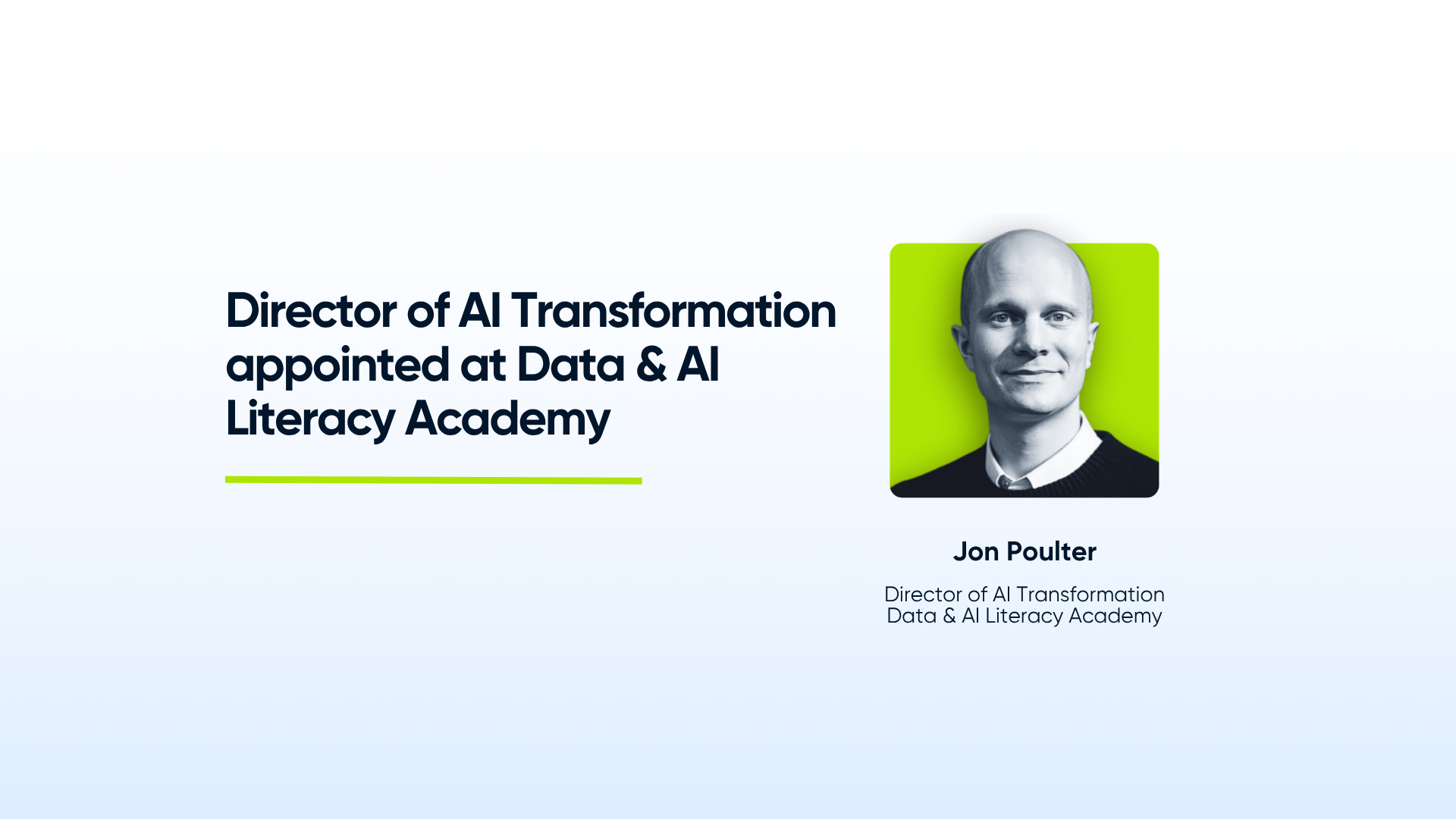
We’ve been leveraging AI internally for the past few years, and expanding our executive team with a Director of AI Transformation was the logical next step.
Jon Poulter joined us as our Head of Operations. In the past year, his depth of thinking and strategic direction have delivered foundational shifts in the ways we work. AI has been at the core of our operational developments, so we thought it was time to give you an insight into how this is run.
The defining principle of good AI transformation
Jon's defining principle is deceptively simple: don’t think about AI transformation as using AI to transform the organisation. The goal is to transform your organisation to best leverage what AI can bring to the table.
Everyone’s role when it comes to problem-solving is to understand the organisation, beyond surface-level symptoms, down to underlying causes and opportunities and then identify which problems are best addressed with AI, and exactly where in the process it should be applied.
Jon shares: ”The temptation is to start with AI and go looking for problems it can solve. The key to delivering value is the opposite; understand and prioritise the problems first, then identify which are best solved with, or supported by, the appropriate application of AI.”
This is not a novel idea. It's the discipline that has always separated good transformation from expensive distraction. What's different now is the scale of the temptation to skip it.
What he's building
Jon's been focused on creating an environment in which unstructured data becomes an accessible, valuable, and widely available asset, reflecting how an organisation actually operates.
The role sits on the exec team, where strategy is defined, a choice that highlights the importance of being at the forefront of leveraging the latest technologies. Where AI is best placed to generate value is shaped entirely by strategic intent. An operating philosophy disconnected from strategic objectives builds an operating model for today that is outdated the moment tomorrow arrives.
Success in the next twelve months looks like a series of targeted initiatives driving measurable improvement in efficiency, quality, accuracy, and consistency of outcome, in the areas that need it most.
Where organisations get stuck
Jon's diagnosis of the broader market is clear-eyed and, at this point, well-evidenced.
The problem isn't that organisations are underinvesting in AI. It's that they're overinvesting in the wrong things. A tool has appeared that, at the surface level, is able to do everything, and the mass of low-hanging fruit it offers is precisely the thing distracting organisations from the transformative value that requires more careful identification and prioritisation.
“It's not ‘what I can do with GenAI?’ It's ‘what is GenAI able to do that has previously been impossible, or very, very difficult?’"
His position on fully autonomous agents is architectural instead of reactionary. LLMs are probabilistic systems, and most enterprise workflows require reliable, auditable, repeatable execution. The flexibility that agents provide is often only needed because the underlying process hasn't been designed with enough rigour to make that flexibility unnecessary. Foundations still and will continue to be a requirement for useful outcomes. No amount of artificial intelligence will reliably surface the right document across fifteen identically-named documents stored within three shared drives.
The architecture he advocates is more precise: a deterministic layer that orchestrates the workflow, an LLM invoked as a targeted capability at the point where unstructured content genuinely requires interpretation, and a human invoked where judgement, relationship context, and commercial authority are required. Nothing decides when to act except the process design. Targeting AI at the point of most value is a harder problem, but it's the more valuable one, and it's where competitive advantage actually lies.
The human angle
Against a prevailing narrative that treats AI transformation as a story of acceleration and headcount, Jon argues something different.
The right human in the right loop is, consistently, the best way to get value from these tools. It isn't about one person doing ten people's jobs. It's about ten people who genuinely know their jobs: the nuances, the complications, what good looks like, positioned to do what they do more effectively, with their expertise concentrated at the point of most value.
The goal is to absorb the volume triage and the finding, so the human role concentrates where it's irreplaceable: judgement, relationship, and authority.
"What I'm trying to build, what I'm trying to change, is ways of working, not the work itself."
When you give genuinely capable people the capacity that comes from removing the parts of their roles that aren't value-add, you find out what they're actually capable of. That, in Jon's framing, is where transformation comes from.
Related blog posts
.png)

.png)
.png)
.png)
.png)
.png)
.png)
.png)
.png)
.png)
.png)
.png)
.png)

.png)
.png)
.png)

.png)
.png)

Unlock the power of your data & AI
Speak with us to learn how you can embed org-wide data & AI fluency today.

